It's been said before here during this fun little All Shook Down exercise, and it bears repeating—as the Replacements wound down their career as a band on this one final record, we essentially heard songs that fell into three categories:
1) Genuinely terrific Replacements tunes that they were able to churn out as if nothing was about to end. "Merry Go Round," Nobody" and "When It Began" being the primary three.
2) Efforts by Paul and some form of the band to recapture the old sound that, while all having fine moments, didn't quite get to where they/he wanted. "One Wink At a Time," "Someone Take the Wheel" and "Attitude" are prime suspects.
3) Songs that pointed to a clear path forward to Paul Westerberg as a solo artist. We'd heard the Paul-centric efforts before ("Here Comes a Regular," "Skyway," "Androgynous" and more), but we'd never heard quite so many on one album. "Sadly Beautiful" and "All Shook Down" are prime examples of Paul forecasting what was to come. Two others will follow on All Shook Down.
The first of those efforts shows up today. The 11th track on the album and the shortest Replacements song since back in the Twin-Tone days: "Torture."
To me and maybe only me, this song is the one that truly feels like a Paul Westerberg solo effort, a song that prolly would have done just fine on 14 Songs, which would be out in three years. "Sadly Beautiful" by itself is no different that "Skyway" was, right? A Paul effort done in the clear spirit of the Mats. Even the title track, for all its dusty somnambulance, had that subversive Replacements zig-when-you-think-I'm-about-to-zag quality to it.
But not here. There are songs on All Shook Down that sound like the Replacements, and there are songs on All Shook Down that sound like the Replacements trying to sound like the Replacements. And there is just one song that sounds like Paul isn't just moving on, but has moved on. For good. That's "Torture."
A million baby kisses from a kissing booth on wheels This sign is pretty poison on the envelope she seals Your love is by the way who knows exactly how she feels Whose torture Without you, it's torture What new
You climb into your rocket ship and count from ten to one
There's no television coverage for that loser on the run
You hide yourself in darkness but we're heading for the sun
Whose torture
Without you, yeah torture
What to do, it's torture
Tighter and tighter and tighter soon
Yeah torture
And 809 is rockin' with a party full of lies
And on the tenth floor smokin' til the sun's about to rise
There's trouble in 302, can't you see it in my eyes
Whose torture
Without you yeah torture
What to do, it's torture
Ooo torture
Look. I don't really know what the hell Paul is singing about here. But he sure ain't happy. "Torture" is the final ever example of that wonderful Mats trick of taking some seriously troubled and downbeat lyrics and matching them up with a catchy as hell tune. "Little Mascara" did it. So did "I.O.U." and "Valentine" and "Asking Me Lies." So did "When It Began" a few tracks earlier on All Shook Down. And so does "Torture."
It's so odd. The song almost plays and feels like a demo, yet it may in fact be the most polished track on the album. Paul offers this lovely stemwinding arpeggio that is as melodic as anything he has ever done, and it spins the track upwards into the atmosphere. His lyrics are clear, cool and precise, filled with lithe little witticisms and turns of phrase that made Paul famous(ish). ("You hide yourself in darkness but we're heading for the sun" is particularly awesome). It's downright pretty! And how often do we say that about Replacements tunes? Pretty and supple and catchy...and it makes it 100% clear that the Replacements are a spent force and we will never hear from them again.
Fun, huh?
In many ways "Torture" doesn't really belong on the album because it so clearly is not a band track, not even a smidge. Again, I think it could have worked pretty fine alongside poignant songs like "Things" and the magnificently incomplete "Black Eyed Susan" on 14 Songs. But then again maybe we did need to hear this. Maybe we did need to hear what was left behind and, just as important, what was soon to come.
Paul Westerberg would embark on a solo career two years later with the wonderfully goofy "Dyslexic Heart," and soon enough he would begin cranking out solo albums that would take him all over the map. Some were great, some were okay, all were interesting. And I think "Torture" can hold its place with some of the best solo ballads he ever did. As a Replacements track? It's lost and meandering and struggling to fit in. On All Shook Down or anywhere else.
But then again, lost and meandering and struggling to fit in sounds an awful lot like a certain Minneapolis-based quartet we've been writing about these past few weeks, dunnit? So perhaps it has its perfect place on this farewell album after all.
The truth is Paul Westerberg has never really fit in, nor have the Replacements. And I for one cannot picture a world in which they did. And honestly, would we want them to? Because when you think about the Replacements even trying to belong, to be part of the crowd, you know what Paul, Tommy, Chris and Slim just might have considered that?
One of the bedrock hallmarks of the Replacements was their myriad dichotomies and contradictions. And one of those is the way they all would go back and forth between searing honesty and flippant bullshit, sometimes in the same sentence.
Paul Westerberg once talked about his refusal to give 100%. "I guess it's the fear of failure. I don't want to give everything and have it turn out to be shit or have people not like it. I hold a little for myself. I'm lazy, too. [...] 'I.O.U.' has a nonsense chorus. I could sit down and get words to fit that, but I figure it doesn't need it. It sounds good enough to me."
It's not hard to look at even some of their greatest songs and pick out the word or line which would seem to prove this admission true.
"Happy Town" is one of the shortest songs on an album of short songs. And it's interesting, because it feels like, for once, rather than go with a line or two that are just okay, or a nonsense chorus that sounds good enough, Westerberg simply decided to go minimalist; if there are few words, less chance of them being wrong, perhaps. And the result is a hard, snappy little gem which says its piece and gets out. And what's more characteristically dichotomic than a song called "Happy Town" about a place which is neither a town nor in any way happy?
The track begins with the sound of the band—or Paul and Tommy, at least—warming up and noodling slightly, in an atmospheric way, before the song proper kicks in.
And what a lead-off. Westerberg didn't lack for great opening lines, and if this doesn't quite reach the level of:
Read about your band in some local page
Didn't mention your name
Shared a cigarette for breakfast
Shared an airplane ride for lunch
You and I fall together
You and I sleep alone
Look me in the eye then tell me that I'm satisfied
Well, a person can work up a mean mean thirst after a hard day of nothin' much at all
I'll write you a letter tomorrow
Tonight, I can't hold a pen
it's certainly no embarrassment of a cousin, and the rest of the song keeps pace:
The plan was to sweep the world off its feet So you sweep the garage for the neighbors to see
The plan was to set the world on its ear
And I bet you don't know why you're here
The loose vocal triplets which lead into the chorus are an interestingly theatrical touch which adds just the right amount of musical tension, and will get more overt with each subsequent verse until it's nearly Broadwayian.
Who knew that avenue was bound for happy town
Happy town
Happy now
Happy town
Actors, authors, artists and thieves
Have afternoon parties where nobody heaves
Former strippers and junkies and men of the cloth
And we all fell in line and got lost
It's interesting to note that Westerberg seems to feel actors, authors and artists are natural peers of thieves—and that just when he was trying heroin for the first time, he puts junkies in the same categories as strippers and men of the cloth.
Who knew that avenue was bound for happy town
The plan was to set the world on its ear
And I'm willing to bet you don't last a year The plan was to set the world on fire
But it rains every day on the liar
In happy town
One of the things which makes "Happy Town" unusual in the 'Mats oeuvre is its lack of a bridge. (That and the organ solo played by fan and Heartbreaker Benmont Tench.) Not having a bridge might be one of the things which makes the song feel even briefer and lighter than its barely 3 minute run time.
The outstanding 'Mats book Trouble Boys postulates that in addition to being about Westerberg's dislike of rehab, this is a warning kiss-off to his soon-to-be-ex-bandmates—especially the "I'm willing to bet you don't last a year"—and maybe so. Maybe so. In fact, it probably is. But even more I think it's a classic example of Westerberg pointing fingers and flipping the bird to others when he's really talking to himself. Even if he didn't know it.
There have been bigger bands. There have been (sorry, boys, you know how desperately I love you but you also know it's true) better bands. But there has never been a band quite as contradictory as The Replacements.
Paul Westerberg himself once said something along the lines of there being other bands who could do the loud stuff as well as they did, and other bands who could do the quiet stuff as well as they did, but no one who could do both as well as the 'Mats. And pretending for the moment that the Beatles never existed, that seems obviously true to me.
For all their third record's "Color Me Impressed" and "Within Your Reach" were the songs which announced that the 'Mats were so very much not your typical punk band, for obvious reasons, in some ways it was actually "Treatment Bound" which announced their presence with authority.
[They themselves later admitted that their early hardcore phase was a pose, and something at which they weren’t especially good. I think they’re mistaken about how not-good they were; they may not have actually loved hardcore, but they were damn good at playing it.]
To call "Treatment Bound" a lazy shuffle would be the most understated of understatements; that it falls apart in the middle is far less surprising than the fact that they're arsed to pick it back up and finish it. And yet, for all its lyrics seem to proudly display their beer-soaked loutishness, there's actually a hint that maybe, just maybe, they're whistling past the graveyard and know it's not the smartest way to conduct themselves but they either don't know a smarter way or they're too scared to try. And one of the reasons there's that subtext is even as he's singing about getting shitfaced before the gig, Westerberg is utilizing the kind of wordplay which none of his peers would ever think of attempting, much less be able to pull off. It's that dichotomy—singing about being drunken buffoons without a high school diploma and using the language with a deftness that Cole Porter would have admired while stumbling through a perfectly crafted pop song—that made the Replacements the 'Mats.
They, of course, continued to record songs which were neither rockers nor ballads on subsequent albums: "Androgynous," "Answering Machine" and "Waitress in the Sky" becoming some of the most beloved and characteristically Replacements songs in the 'Mats oeuvre.
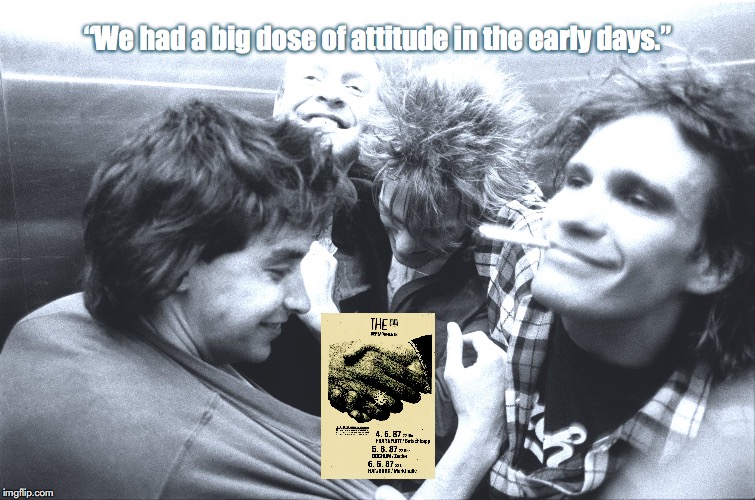
"Attitude" is that kind of in-the-middle song at which the Replacements excelled. Famously the only song on the album which features all four members, it starts in classic fashion, with Westerberg beginning the count-in, pausing, laughing slightly, and then rushing the rest of the count. Naturally, the entire band falls in perfectly.
It's a fine performance. Westerberg's acoustic is mixed most prominently, along with Chris Mars's drums, apparently played with brushes. Tommy Stinson's bass bumps along agreeably, while Slim Dunlap drops in sweet bits of electric guitar color throughout. It's not exactly impressive to say that it's far more polished than "Treatment Bound," but it's also considerably smoother than their classic if again not precisely Steely Dan-like "Waitress in the Sky" recording.
Well when you open that bottle of wine
You open a can of worms every time
Now you don't stop, that ain't true
Never said a word, I never had to
It was my attitude
that you thought was rude
It was my attitude
Old habits are hard to break
And I don't know how much I can take
What I think is on the tip
Of my tongue though I let it slip
It was my attitude
that you thought was rude—not me
It was my attitude
that you thought was rude
Remember sitting back in school
I held my tongue until it turned blue
They said I had an attitude
You just failed my test
'Cause I know you be the best
So wipe me off as you conclude
A POV is what I can't use
I got an attitude
Said I had an attitude
The problem is that as enjoyable as "Attitude" is, it feels like "Treatment Bound" redux, a bunch of hooligans talking about how naughty they are. But the thing is, they're not kids anymore. They're all adults now—hell, Slim's kid was nearly an adult by this point—and it's just not that amusing anymore. Now it's mainly just sad. Especially because it feels like this time they're somehow maybe even less aware of what poor decisions their poor decisions are, or at least are pretending to be. And it's all compounded by the fact that the lyrics are often individually good but don't really build to anything— just the opposite, unfortunately, as while Westerberg's personification of his own personality flaw in order to enable himself to avoid taking any kind of responsibility for his own actions is clever, in the end, the opening couplet is the strongest of the entire song is by far.
And there's one more thing which makes it a bit of an uncomfortable experience. It would be bittersweet to hear the last true Replacements recording, no matter what. But that it's this song, with its gentle musical lilt, softly sung in a professional manner by Westerberg—no hoarse shouting, no bum notes kept in, not this time 'round—featuring absolutely wonderful, tasteful drumming from Chris Mars of the exact feel and on the exact type of song Westerberg and Stinson would claim he was unable to handle—makes the entire thing a bit bizarre.
That the final 'Mats recording is so professional and polite even as they're claiming they're rebels, is a dichotomy, but not the kind at which the 'Mats excelled and which made them so damn special. It's disquieting. That it shows that Mars had far more range than his bandmates could admit is oddly disappointing, or perhaps strangely vindicating. And you can't help but wonder if the closing line—"A POV is what I can't use"—is Westerberg admitting in song what he can't actually admit to himself, never mind his soon-to-be former bandmates.
When the Beatles were recording Abbey Road's "Oh! Darling," Paul McCartney woke up every day and went to the studio and before saying a word to anyone would record his lead vocal track, looking for a certain rough first thing in the morning quality. Apparently, each time he'd lay down a great vocal, say it wasn't good enough, and come back the next day to try again, before finally getting a take he was happy with. (As well he should be, as the final result is spectacular...although John Lennon didn't think so, and thought Paul should have let him sing it. Siblings. What are you going to do?)
The title track to All Shook Down sounds exactly like that, only in reverse. The vocal sounds like it's about 3:15 in the morning—or maybe even 6:30 a.m.—and the singer hasn't gone to bed to yet; after a long day's night, he's the last man standing, and he's too wired to go to sleep, even if he's absolutely exhausted. And so what can a poor boy do except sing a tender dirge?
Apparently, that's just what Westerberg did. He laid under the piano in the studio and sang snippets out of a notebook. Which is how you get this glorious mess that will often almost seem to make some sort of profound sense and then suddenly veer off into near Joycean (or at least Edward Lear) gobbledegook...and yet. And yet throughout it retains a remarkably gripping power. Because while the vocal style is reminiscent of McCartney's technique from 20 years earlier, the lyrical technique prefigures Kurt Cobain's writings, especially those which would shortly change the world, in a mere 369 days.
Like Cobain, Westerberg has an ability to take an arresting line—or even a phrase or just pair of words—and explore or, more often, juxtapose them against another equally interesting combination of words having nothing to do with the first and yet somehow all the richer for being limned against each other. Often impossible to parse in a literal sense—although delightful to try—there's a certain energy that comes along with something non-linear that in some way manages to speak directly to the heart.
It's a deceptively difficult way to write; plenty of composers attempted to write whimsical lyrics in the aftermath of Bob Dylan's breakthrough, or John Lennon's "I Am the Walrus" period and few (virtually none) succeeded, and the rock landscape was littered with sad grunge wannabes in the wake of "Smells Like Teen Spirit" who thought all that was needed was to put some absurd emo babblings together and emote embarrassing and rock immortality would be theirs. They eventually found out it was not to be, quite a bit after the rest of us realized it.
But not Westerberg. Several extremely large steps above most good writers, here even hung over and strung out, he manages to string together a lyric whose meaning simultaneously flutters just out of reach and takes permanent root in the listener's soul. All while going back, again and again, to a typically Westerbergian piss-take, different in absolutely every way imaginable, on one of the King's most famous hits. And, again, in oh so Westerbergian fashion, he takes elements of his own life—in this case, the fact that he was at that exact point experimenting for the only time in his life with heroin—and combines it with exaggeration and surrealism and produces gold.
Hollywood cops shoot each other in bed
And I wouldn't go to see 'em they put the checkbook to my head
Tinkertown liquors and emperor's checkers
Some shit on the needle, like your record
The fifth gripping week an absolute must
One of the year's best ain't sayin' much
Throwin' us trunks as we're starting to drown
We're all shook down
She don't do dance and she don't do us
The black and white blues oh yeah I got 'em in color
The fifth gripping week an absolute might
One of the year's best in sight
They throw us trunks says we're starting to drown
We're all shook down
Praises they sing a register rings
One of the time that nobody brings
Praises they sing shake my hand as I drown
All shook down
The impact of the recording itself cannot be underestimated.
The woozy feeling is clearly genuine, from Westerberg's barely-loud-enough-to-be-considered-a-whisper vocals to the tape loop of his breathing, to Steve Berlin's delightfully creepy yet lovely ocarina, it's one of the most fully realized tracks on the album even as it seems on the verge of collapse at any second.
All Shook Down comes across as a mishmash of songs loosely connected by a theme of disillusionment and ends. Some of the songs work absolutely perfectly, whether they are rockers, semi-ballads or deathly quiet meditations. Others don't quite work so well, lacking something that used to seem to come so naturally to the band. I wouldn't say there are any bad songs on All Shook Down, just some that aim for a mark with which the Replacements have always been so used to hitting and, well, they just miss.
Not "When It Began," today's installment. To me this is the Mats firing on all cylinders as a power pop band, a final callback to one of the things they did best over the final 5-6 years of their career when they got a little more serious about making truly great songs. This one falls into a category with "I Will Dare" and "Kiss Me On The Bus" and "Alex Chilton" and "Valentine" and "I'll Be You" and "Achin' To Be" and more. It's not as rough as some of the earlier stuff, nowhere near as loud as classic rockers like "Color Me Impressed" or "Favorite Thing." But it's alive, it's fun, it's edgy, it's perfectly written and, maybe more than any song on the album, it shows maybe where the band could have gone had they kept it together.
With its country jangle that would have made R.E.M. proud and may have even given Wilco some ideas way back when, "When It Began" is fully bathed in this pop glow the band so often could trot out and give the what-for. It sounds light but it's really not; there's a touch of menace underneath the somewhat unorthodox chord progression. It bounces along but it's got enough teeth to leave a mark, and the heightened pace is cheerfully juxtaposed against (where have we heard this before?) lyrics that are anything but. And it paints quite a telling picture of where the Mats were when they pressed "RECORD" on this track.
Stop at a light that shined bright blue
And where you been is still in view
You stopped at nothing at your first chance
Now it's nothing like when it began
Long ago, or yesterday
The queen sits quiet, the jester plays
She plays, "Off with their heads and on with my pants"
Oh it was something when it began
Oh and nothing? That's something I understand
I'll dance to try and make you laugh
I'll play the fool, the king at your command
Oh yeah - HEY!
I never had to bow to you when we began
And I can play you a tune at your command
Oh, and if you say nothing, well that's something I understand
When it began
When we began
When it began
Okay, Paul. I guess goodbye to you, too.
Most bands don't intentionally tell people they're done in song. Sure, some did it with much acclaim and fanfare. The Beatles left fans with the entire second side of Abbey Road, little snippets of this and that which rolled into one huge suite that was irresistible and unforgettable. Cream had an entire album called Goodbye which, well, showed why breaking up was a good idea. Other great bands just walked away (The Police, R.E.M.) or came to a screeching halt (Nirvana, the Sex Pistols) without much adieu. But the Mats did say goodbye to each other, to fans, to the label, to detractors, to rival bands and to anyone else who mattered on All Shook Down. And the true farewell is found in the form of "When It Began," and a chance for Paul to get a bit nostalgic while still unleashing at least a bit of venom one final time. And it works just beautifully.
Paul brings out all his tricks for "When It Began." The absurdities (a traffic light being blue?), the humor ("Long ago...or yesterday"), the word games ("Off with their heads and on with my pants"), and then he wraps it up with a line for the ages, one which may define the Mats in their final incarnation as well as "Swinging Party" did ("If being afraid is a crime we'll hang side by side") in their heyday.
"If you say nothing, well that's something I understand."
Is that or is that not the Replacements in one damn little nutshell? A band so often paralyzed by the idea of success, so terrified that making a career turn that seemed right could lead them to ruin, that they so often just said "Fuck it" and skidded off the highway. Nothing could have changed that about them, it was in their DNA. And as Paul tells us at the end, nothing is probably the one thing they have always understood. Brilliant.
Like "Can't Hardly Wait" with its horns and stops and Chris' delightful fills, or "Talent Show" with its breakdown and shades of "Portland" at the end, there are so many little touches in "When It Began" that make it great. I've always loved when Paul and others yell "Hey!" at the peak of a song (think "I'll Be You" or "Valentine" or, a few tracks earlier on All Shook Down, "Nobody"), and we get that here too. The slide solo is a new touch (it's Slim, right?) that ups the lite-country factor by a bit and creates this breezy feel that crackles with energy. The band (whomever they may be) singing backup on the outro really does sound like everyone saying goodbye. And those little moments of defiance from Paul that tell us yeah, we're having fun here for now, but don't push me ("I never had to bow to you when we began") is a cool reminder of how tension was such a necessary part of the band's formula.
And finally there's this. Paul always seemed to have high expectations of his fans; he wanted them to truly listen, and listen right to the end. It's why a song like "Favorite Thing," while it seems to ultimately careen into a kind of sweet sentiment at the bridge ("You're my favorite thing, bar nothing!"), it emerges after Bob's gonzo solo with a terrific punchline, "My favorite thing...once in a while.") It's why at the end of "Achin' To Be," after three minutes of describing this unreachable mystery girl, he lets us know who he's really talking about ("...just like me.") It's why as Scott pointed out a week or so ago, he saves one hell of a kicker for the end of "Nobody" (You're still in love with nobody, and I used to be nobody. Not anymore.") Paul doesn't mind making us wait to get the full story; it's the mark of a great songwriter to expect as much of the listener as he or she does of him or herself. Joni Mitchell did it. So did Bob Dylan. And so did Paul Westerberg.
So that's why at the very end he makes it clear he's not talking about the band as some third-party vessel that he is all at once nostalgic for and fed up with, but he's really talking about them. The four of them. Or five of them including Bob, who by this point had been gone for five years. He sends a message not just to the band known as the Replacements, but to the specific members, his brothers for the past decade. How does he do this? Like this:
When it began
When we began
When it began
The "we" makes all the difference in the world and personalizes it in such a way that makes "When It Began" fully realize its lofty vision. It says goodbye and good riddance at the same time. It looks back fondly and scoffs at the past at the same time. And it remembers not only what the Replacements were, but who they were. Bravo.
Because after all, Paul was dead on, and never more right in his career, when he sang this line: "Oh it was something when we began."
For so much of his time with the Replacements, Paul Westerberg was not only the man largely in charge (being the songwriter, singer and frontman will do that to you), but a man on the move. He was so often in motion, always traversing the lines between hither and yon, plotting his next move. The question was, where was he heading? I'm not sure he ever really knew because the direction seemed to change so often.
Let's take a look.
First he was a thrash-happy scoundrel who seemed content to scream out rippers like "Something to Du" or "Kids Don't Follow" all the live long day. Until he wasn't, and he just had to try his hand at "If Only You Were Lonely" (funny how that song keeps coming up, and I swear it's not intentional) or "Within Your Reach." Only he didn't want to be a solo act back in those days; he wanted the band to evolve. So he marched them through the rowdy insouciance of Hootenanny with songs that took them off the funny pages (at least a bit) and into the realm of something deeper. That's where "Color Me Impressed" and "Willpower" came from, even while leaving the door open for the band's riotous side with songs like "Lovelines" and "Treatment Bound."
But still he (and the band) moved on, and Let It Be brought Paul (and the band) on another stunning shift of direction into full-on confessional songwriting, and if anyone can find the equal in terms of that album's postpunk, heart-on-sleeve brilliance, well, please let me know. Because that would be impressive. Who could have foreseen the band that did "I Hate Music" and "Customer" cranking out splendor like "Unsatisfied" and "Answering Machine" and "Sixteen Blue" and "I Will Dare" less than three years later? While still blowing the doors off with "Favorite Thing" (quick side note: that is a PERFECT song) and "Gary's Got a Boner?" And again, they seemed to move to this point in large part due to Paul's inability to sit still. Fear and loathing aside, he just had to keep moving and, in his own way, evolving.
The journey and changes kept coming. First was a new label with Tim and a foray into outright anthemic classic rock (with punk leanings of course) with the one-two punch of "Bastards of Young" and "Left of the Dial." Followed by the momentous decision to kick Bob Stinson out of the band, led largely by Paul and obliquely chronicled (at least I hear it that way) in one of the most important songs Paul would ever write, "Swinging Party," which seemed a farewell to the Bob years and the advent of the next phase.
Next up, more change with the decision to go it as a straight-up trio and truly stretch their legs on the brilliant, genre-bending Pleased to Meet Me. Then, of course, the move to bring Slim Dunlap into the band for Don't Tell a Soul and to try (unsuccessfully) for that long elusive hit. Then the next course correction was Paul's decision to finally go it alone, after more band strife and the somewhat disastrous tour opening for Tom Petty in 1989. Or so we thought, Because then, of course, another turn! In the form of the final U-turn into putting out one final Replacements record. That's what led us to All Shook Down, a decade-long path that had more loops, deceptive turns and illusive twists than an Escher painting.
Sure, the band took this journey and made these directional changes with him, and you can draw a pretty clear line on the band's evolution of sound. But the unique path to get there was pretty palpable. And, naturally, someone had to be in charge. Or, if you will, someone had to take the wheel. So Paul did.
So look where that brings us! To track six of our look back at All Shook Down, the perfectly entitled "Someone Take The Wheel." Almost like we planned it that way. And also known as the moment Paul finally and most plainly announced he was publicly surrendering his leadership role in the Replacements.
"Someone take the wheel, 'Cause I don't know where we're goin'. Anybody say what you feel, Everybody's sad but nobody's showin'."
Do I know that for a fact that Paul is announcing this is the end for him? I do not. But the signs point right at it. Look at the words, starting with that chorus. It sure looks like, just after Paul's at-last plea to his fellow bandmates to please take the reins from him, the next line comes as a tacit admission: "'Cause I don't know where we're goin'." (Later in the song changing to the even more revealing, "'Cause I don't care where we're goin'.") After a decade of steering the band this way and that, towards success and then at the last second, time and again, diving into a ditch to avoid it, after getting rid of Bob, bringing in Slim and pretty much leaving Chris by the roadside, Paul's done. 10 years. Eight albums. That's it. Game over. Someone take the wheel.
So it's an important song in the Mats catalog, at least it should be, for that reason alone. And it feels like the Mats doing their thing. The shouted count-in from Tommy. The profanity and the nihilism ("I see they're fighting again in some fuckin' land..."). The peerless wordplay ("Anywhere you hang yourself is home"...holy shit is that good!). The noodly guitar solo that seems to balance between country jangle and wickety-wickety pop metal. The overall exhausted pace and the somewhat off-kilter bridge that doesn't seem to want to fit but still does. Plus a nice harmony turn towards the end from old Brit rocker Terry Reid. It's all there on "Someone Take the Wheel." The ingredients for a classic Mats ramble are all there.
Which is why I only wish I loved it more.
I mean, I like it. It's a decent song. And if the Goo Goo Dolls or Bush had done it it would be close to the very best of their catalog. But with the Mats, as Scott and I are learning as we do this exercise, you grade on a fairly steep curve. Especially when royalty like "I Will Dare" and "Can't Hardly Wait" and "I'll Be You," to name just a very few of the many perfect rockers they gave us, are always in the mix.
Here's my issue. This should sound like a Mats song for all the reasons I mentioned above, but it doesn't. And it doesn't really sound like a Paul Westerberg solo project. Instead, and maybe it's just me here, but it sounds like a band that is trying to sound like the Replacements. Which is why it just doesn't ever fully work for me.
The Mats never really tried to sound like anyone else. Sure, they on occasion could evoke Big Star or The Heartbreakers or the Dead Boys or even the New York Dolls, but the sound was still always theirs and theirs alone. But on "Someone Take the Wheel" it sounds like they are trying to ape the band they once were. The fact that only Paul and Tommy play on it could have something to do with it, and recapturing the feel the four of them once had with two non-Mats in the room, well, that ain't easy. So there's a level of involvement, a chemistry issue perhaps, that's just missing. And despite some truly fine moments within the song, the end product is just something a little less.
It's not to worry, because they'll get that...that something...back again before the record ends. A few times, actually. They will recapture exactly what it was that made them great, and as a result there will be more great songs coming, and very soon for that matter.
But on "Someone Take The Wheel," the song where Paul finally seems to stop moving and, perhaps, toss it in, the machinery is in place, but the results just don't quite add up. For the first time on All Shook Down we can finally see not only that the end is near, but perhaps why it's near.
It’s funny. For as much as the Replacements are treated as a beloved hard rock/postpunk band, with a preference from many of their longest-termed fans for the really hard stuff, the softer tunes were a part of their DNA for pretty much all of their career. The louder songs likely outnumber the quieter ones, but the latter were still always a part of who the Mats were. Thanks to Paul Westerberg’s ability as a master craftsman when it came to writing sad, longing ballads.
“If Only You Were Lonely” showed what Paul could do as a young balladeer just beginning dip a toe into those waters way back in 1981. But since then, every album since Hootenanny has had not only some quieter and more “serious” material, but also songs that are basically one-man shows for Paul.
Think about it—“Within Your Reach,” “Androgynous,” “Here Comes a Regular,” “Skyway,” and “Rock-n-Roll Ghost” were all largely do-it-all-Paul ventures from Hootenanny through Don’t Tell a Soul. But they were done in the full spirit of who the Replacements were. Because those songs—as well as others—are pretty important in the overall Mats songbook and legacy.
Why? Look. We love the band for who the band was—raw, sloppy, reckless, acidic, impassioned, ragged, heartfelt, needy, drawn and brutally honest. But those harder moments I don’t think have anywhere near the meaning they have if not counterset on occasion with the quieter songs. It's only when brought together that the true ethos of the Replacements can be seen and felt.
And it just makes the Mats that much more fascinating and effective. It’s why “If Only You Were Lonely” functioned so well as a b-side to a banger like “I’m In Trouble.” It’s why “Androgynous” flows so seamlessly after a goof-rocker like “Tommy Gets His Tonsils,” and why “Here Comes a Regular” is not just a perfect capper to Tim, but provides such a devastating contrast to the battery acid fury of “Little Mascara.” People can say plenty about the band’s fears, insecurities and self-destructive hubris. But you had to give it to them—they by and large knew how to lay out an album. And they knew the need to give both sides of the coin, the sour and the sweet, to these records.
And, of course, they knew the value Paul brought with those softer moments. So that brings us to “Sadly Beautiful,” one of the most delicate and gorgeous songs Paul (or anyone else) has ever written.
On an album where people expected Paul to be going it alone more often than not without Tommy, Slim or Chris, this track—the album’s fifth—is the first example of that happening. No, it won’t be the last. But I have always appreciated that he waited until track five, right after the fastest song on the album (“Bent Out of Shape”) to unveil “Sadly Beautiful.”
“Sadly Beautiful” is so sparse it almost seems avant-garde, experimental, although this is no demo. This is a complete and thoroughly realized vision of a song. Paul and guest musician/avatar John Cale fill “Sadly Beautiful” with such a haunting level of melancholy that it is hard to not feel it pull at you. Three instruments—Paul’s weary voice, his dusty, desolate acoustic guitar and Cale’s mournful viola—are all you need to let “Sadly Beautiful” envelop you the way the best Mats’ songs of years’ past used to.
“From the very first day you were born,
To the very last time you waved and honked your horn,
Had no chance at all to watch you grow
Up so sadly, beautiful.
“Baby needs a brand new pair of eyes,
‘Cause the ones she’s got now see only goodbyes.
Had no chance at all to let you know,
So sadly, beautiful.
So sadly, beautiful.
“Well you got your father's hair,
And you got your father's nose,
But you got my soul.
Sadly, beautiful.
“From the very last time you waved and honked your horn,
To a face that turned away pale and worn,
Had no chance at all to let you know
You left me sadly, beautiful.”
This is heavier stuff, maybe, than most Mats fans were used to. The subject is a bit nebulous as always; it could be a parent saying goodbye to a child? Possibly a mother bidding farewell to a child going to live with his or her father? I suppose it could be a love song—perhaps Paul is singing to an ex, telling her while she was born with traits only her father could give her, the author's soul is something she earned. Could be. But it’s really not that important—the song is a lonely and almost funereal goodbye, and every corner of it works.
Listen to the way Paul speaks the word “beautiful” just before Cale’s ethereal viola solo takes over. Or the ghostly way his voice barely can offer the stunning choice of words, “pale and worn.” Or Cale’s gentle bowed response every time Paul utters the word “sadly.” This is deeply personal, intimate, and the pathos and emotion behind every note and syllable invade the room as the song plays, like a spirit billowing through the drapes.
As Scott and I have discussed so far, All Shook Down has more than a few high points and more than a few that, frankly, just don’t quite make it. “Sadly Beautiful” is one of the former, hitting towering heights while barely rising above a whisper.
Being able to elevate above the ash and ruin with quieter moments was an ace the Mats always had up their sleeve (again, think “Skyway” or “Sixteen Blue” or “Achin’ to Be”), and for that reason, even though “Sadly Beautiful” is one of those examples of Paul going it mostly alone, it remains a Replacements song through and through.
We’ll hear more on All Shook Down from Paul going it mostly alone, but we won’t hear it done any better. How could we when “Sadly Beautiful” offers it up so flawlessly?
When we were discussing the J.D. Salinger short story "A Perfect Day for Bananafish" back in high school, the teacher was talking about the way Salinger used color as metaphor throughout the story. I found this to be utterly specious in a "sometimes a cigar is just a cigar" sort of way, even though I probably wouldn't encounter that actual phrase for years. Essentially, I thought the teacher was full of shit and that you could read almost anything you wanted into any piece of art.
I, of course, was almost certainly wrong, and Salinger was absolutely utilizing color in a coded manner, among many other literary techniques. What's more, in retrospect, for many reasons, that teacher was one of the best I would ever have. (Shoutout to Dan Marcus!)
[The collection of Salinger short stories was, of course, called Nine Stories and was, of course, the inspiration for the title of Paul Westerberg's first solo album, 14 Songs.]
Being full of shit is something the Replacements know all about. They dealt their entire lives with people who were full of shit, from when they were growing up, to their time in the band and, undoubtedly, afterward. What's more, if you read enough interviews, they themselves have admitted over the years to being full of shit in various ways and at various times. Pretending to be hardcore punks on the first two records, for instance, or pretending to be mainstream rockers in some of their final videos in ways that are transparently uncomfortable...and yet they're doing it. Kicking Bob Stinson out of the band for substance abuse, when the other members were very nearly as bad and, in fact, had encouraged his drinking in at least one famous and heartbreaking example. And obviously any time they had to deal with a record label they were likely getting yet another unpleasant experience of dealing with someone full of shit up to their eyebrows and beyond.
All of which is to say: prepare for what is an analysis likely chock full o' shit.
"Bent Out of Shape" is, on one level, another good—perhaps even very good—but not great Replacements song. I'm a hardcore 'Mats fan, so when it comes to them, "good but not great" is generally more than good enough for me. But when looked at objectively, given just how transcendent they could be, "good but not great" can also translate into serious disappointment. When you're capable of winning the Super Bowl, merely making it to the conference championship just isn't enough.
And that's what this song seems to be. It's got some of the trademark Westerberg wordplay, such as "you wanna be a dancer and I'm on my last leg." It's got some nice examples of the narrator clearly lying about how they feel, talking repeatedly about missing their face, about not feeling good, that their friends can all see it, and yet then claiming they've never felt better—meaning the narrator's either bipolar or lying, and my money's on the latter.
But there's another possibility. Not that the narrator's not lying, that seems obviously the case. It's that the narrator of the song isn't Paul Westerberg or even a fictionalized version of him. I think it's most effective and affecting if the song is written from the point of view of a woman who's just been in a relationship with another woman and is shattered by the breakup.
If so, it would be highly unusual, but not without precedent. The Bruce Springsteen song "Car Wash" is written from the POV of a woman named Catherine. And as Westerberg himself showed with "Androgynous," he wasn't afraid to focus on sexual orientations which in the 80s most songwriters, even in the alternative rock world, would shy away from.
There's popcorn for dinner, last night it was cheesecake
A little sleepy-time tea spiked with another heartache
I smell your hair on the clothes I wear
I miss your face
Can't you see I'm bent all out of shape
You got me bent all out of shape
I couldn't lie if I tried
Yeah you kept me straight
It don't feel so good
But it made me feel great
Bent out of shape
You wanna be a dancer and I'm on my last leg
Call but you don't answer I call again tomorrow
I call again today
I smell your hair on the clothes I wear
I miss your face
Can't you see I'm bent all out of shape
You got me got me bent all out of shape
I couldn't lie if I tried
Oh you kept me straight
It don't feel good
But it's gonna feel great
Bent out of shape
I don't need no lover
I don't need no more friends
They tell me to forget her
They tell me to forget her
But I never felt better
I smell your hair on the clothes I wear
I wear your face
Can't you see I'm bent all out of shape
You got me bent all out of shape
Well my friends all say it shows, it shows
Now I don't care who knows
And that feels good
It made me feel great
Bent out of shape
Got me bent out of shape
Lock me up
The way Westerberg transmogrifies some of the repeated lines ever so slightly, so that "it don't feel so good but it made me feel great" morphs into "It don't feel good but it's gonna feel great" and finally into "Now I don't care who knows and that feels good—it made me feel great" is a deft touch. And the very last line ("lock me up") is interesting in its incongruity—it reminds me, tonally, of the "take it, it's yours tag" on "Bastards of Young," and adds a layer of desperation to the song which raises the entire thing a notch or two.
Musically, the song is like too many on the last two 'Mats LPs (and subsequent Westerberg solo albums), sounding like generic if good mainstream rock. I mean, if not for Westerberg's vocals, this song could pass for Bon Jovi or even Ratt. However, special note must be made of—and major props must be given to whoever's playing—the lead guitar obbligato running throughout the piece, which resembles nothing so much as Lee Ranaldo or Thurston Moore trying to sound like Robert Fripp's Wimshurst machine guitar on Brian Eno's "St. Elmo's Fire." It's pretty extraordinary stuff, and not quite like anything else in the Replacements repertoire.
In the end, it's either a groundbreaking experiment in genderbending, or it's another enjoyable Replacements song with moments of brilliance but which never quite cohere the way it needed to in order to achieve top-level 'Mats. And there are certainly worse fates for any song than to be a good but not great Replacements track.
"Merry Go Round" kicked All Shook Down off with a vengence. "One Wink at a Time" brought things down in more ways than one. And then came "Nobody."
The third track is everything its predecessor wanted to be and wasn't and then some. It's another in an even by then long line of Paul Westerberg semi-ballads—meaning songs such as "Unsatisfied," "Achin' to Be," "Within Your Reach," even arguably "Little Mascara" or "Answering Machine," which aren't really ballads in the conventional sense, but where the tempos are mid-range but the heart is worn on the sleeve even more obviously than usual...and for Westerberg, that's saying something.
But unlike the previous track, on "Nobody" absolutely everything goes right—when it comes to the recording, that is, if very much not for the narrator or his subject.
There have been few writers in rock and roll quite like Paul Westerberg. He doesn't have Bob Dylan's intimate knowledge of poets famous and obscure. He doesn't have Stevie Wonder's unreal melodic imagination. What he does have is a knack for wordplay rarely even attempted, never mind equaled, by anyone since Cole Porter.
Westerberg finds unusual phrases, and double or even triple meanings in words, and delights in surprising juxtapositions. The opening to "Nobody," for instance, is a perfect example:
Heartaches on your wedding day
The one thing, of course, which a wedding day isn't supposed to have is heartaches. (Well, isn't it ironic? Don't you think?) Which instantly raises the question of whose wedding day and are they the one with the heartache? Also, is it more than one heartache, or is it that the heart aches? Whatever it is, it's hard to imagine any of the peers of the Replacements—R.E.M., Sonic Youth, the Minutemen, Hüsker Dü, the Pixies, Dinosaur Jr—coming up with that opening.
The second line clears things up:
Double takes when they look my way
Obviously, it's not likely it's the singer's wedding.
Knees quake, there ain't a shotgun in the place
You like the frosting, you just bought the cake
Your eyes can't fake
The juxtaposition of the inherent violence of a shotgun wedding with the presumed sweetness of a wedding cake is absolute perfection. As is comparing the cake itself—substantive if not necessarily healthy—with the frosting, which is of course nothing but empty calories designed for temporary pleasure, both in terms of visuals and flavor.
And then we get to the chorus:
Still in love with nobody
And I won't tell nobody
And almost immediately the song shoots to the very top of the pile of Great Paul Westerberg songs—and that's a pretty tall damn pile.
It's interesting that with the last two lines of that first verse, this song could very easily have gone down an Eagles-like path of comfortably consumed misogyny. But as Westerberg had already proven several years before with "Androgynous," he was not just an unusually gifted songwriter, he was unusually woke for a straight white guy who grew up in the midwest in the 70s. But that chorus takes any hint of derision or blame away from the song's object and instead they enter into an unspoken conspiracy, putting them both on the same level, and yet in a remarkably sympathetic and unjudgmental way—especially surprising given, as the very first line highlights, the emotional turmoil of the situation.
The bridegroom drags you 'cross that room
Said "I do" but honey you were just a kid
Your eyes said I did
The first line of the second verse are interesting in that it's a standard wedding scene, one most people have witnessed, in person or in a movie, and there's nothing really untoward about it...except that, given the context of the first verse and chorus, it has at the very least a melancholy—rather than joyous—feel, and possibly even ever so slightly sinister. And then, with those last lines, we have classic Westerberg wordplay of the sort never even broached by even the finest writers of his generation, as he takes the most famous and common of wedding phrases and spins them around.
Still in love with nobody
Nobody, nobody
And I won't tell nobody
Take a look on your wedding night
In your wedding book see what name I signed
We'll get back to this devastating bridge—which, oddly, seems to modulate down a full step, an unusual move for a pop song—in a bit.
There's a guitar solo, back in the original key, almost certainly played by Westerberg, and it's an interesting one. It's relatively tasteful—perhaps a bit too raucous, tonally, to really be tasteful—with a plethora of bends. It's mainly half and whole notes, with a sprinkling of quarter notes and only a few eighth notes, and no sixteenths. It's somehow reminiscent of solos such as "Smells Like Teen Spirit" which restate the melody, despite the fact it's got nothing in common with the song's main tune.
We get the final verse, which is a return to the wedding reception, and more of the same sad scene:
Hips shake to the band for old time's sake
Now you make your getaway and you're waving to the stage
Note that reference to the stage—we'll get back to that too.
Another dive into the chorus, but this time the plot doesn't so much thicken as a key detail is revealed:
But on the last page says
Love nobody
And I won't tell nobody
Yeah you're still in love with nobody
And I used to be nobody
Not anymore
And that's the final arrow that pierces both the veil and, fatally, the listener's heart. The multiple uses of the word "nobody" suddenly become multifaceted, as they can now all mean at least two and often three things. All along we've been told that there's no one she loves. But it turns out that it's the narrator with whom she's still in love. He's the nobody in question. What a beautiful twist of fate.
Except by calling himself "nobody," further questions are raised. Is he merely being self-deprecating? Does he mean it? Does he feel he's no one if he's not able to be with her? Is he perhaps referring to the state of his career?
Because as with so many things Westerberg, especially around this point in his catalog, it's easy to look at his lyrics and see how they could very well apply to not only his romantic interests, but to his relationship with his bandmates, or the music industry at large. And after the near misses of Pleased to Meet Me and especially the designed to be a mass hit Don't Tell a Soul, it's not difficult to view this song as a metaphor for his failed love affair with the music industry, especially given that it was produced by Scott Litt, who'd had such monstrous success with R.E.M.
Looked at through this lens, the hips shaking to the band for old time's sake, the getaway, the stage, they all seem redolent of an epitaph, especially with the benefit of hindsight.
Except Westerberg was the one who'd tried to leave the band, tried to make a solo album. He was the one who'd had one foot out the door for some time. So perhaps projection on his part? Maybe this song is actually from the POV of the other band members, who were far from unaware that Paul had fallen out of love with the band?
But let's take a step back to that bridge. It's a devastating couplet...but, really, who looks at their guest book on their wedding night? Is anyone really that disinterested on that night of all nights? Is she really that not in love with her now-husband?
Maybe. Or maybe it turns out that the heartbroken and heartbreaking singer of this fabulous song is the most unreliable narrator since Holden Caulfield (or Patrick Bateman). Maybe she's perfectly happy and he's just a Nice Guy™ standing there internally screaming "you'll be sorry! He can't love you like I can! You'll come crawling back, just you wait!"
But probably not. More likely the singer's reliability is as solid as the word "nobody."
Lyrically, the song is a masterpiece, with more exquisitely parsed out detail than most excellent short stories. Musically, the song is perfection, with the gentle acoustic guitars, and the electric guitar solo that's both graceful and searing. Westerberg's vocals are some his best, with his approachable timbre tinged with his rock rasp perfectly carrying his extraordinary melody: the lyrics and the tune are, unlike the bride and groom, a perfect match. Harmonically, the song is mainly a I-IV-V composition, with brief but vital dips into ii and vi chords to lead into the chorus.
The credits for All Shook Down are notoriously hard to parse, with "Attitude" being the only one that's definitively known to be all four band members. So there's no way of knowing for sure who's playing drums on "Nobody," but I'm pretty much convinced it's Chris Mars. The playing is sparse and tasteful and restrained in a way that the famously untrained and practiced Mars wasn't thought to be—but the drummer on this track sounds just like the guy who played "Can't Hardly Wait" and, especially, "Achin' to Be,", most clearly in the hi-hat pattern—those quarter notes on the almost but not quite entirely closed hats are extremely unusual for a ballad (or balladish) song, and the fact that Mars had played it on the earlier "Achin' to Be" indicates that either he's also the player here or that—despite Westerberg's later claims to the contrary—his was precisely the sound Paul was searching for, and either he or Litt requested this approach, or the drummer himself had heard enough 'Mats to know exactly what to do: play like Chris Mars.
Because you know who was a better drummer for the Replacements than Christopher Mars?
In hindsight, there are few clues to where Paul Westerberg's solo career would go post-Replacements than the second song off All Shook Down.
The song starts with just Westerberg's murmured vocals and his acoustic guitar, but unlike, say, "Unsatisfied" or "Bastards of Young," when the rest of the band comes in, they sidle, rather explode or bash or pop. Westerberg may have used polished studio vets rather than his hometown homeboys, but there's a certain...off-the-cuffness to it, shall we say (although half-assedness might be more accurate). And yet somehow there's a polished sterility about it.
His slightly gruff Everyman vocals are as accessible as always, especially since he's in softer mode here, with only a hint of some of the odd gutturalisms with which he peppers "Merry Go Round." Steve Berlin's horn honks agreeably if unnecessarily in the background, like a chill goose stopping by on his way to or from the frozen north.
The lyrics have plenty of those phrases or unexpected twists that no other post-punk writer would even think of, but none are nearly as effective as the second verse
Baggage claim is this way
So watch her walk down that way
In a hurry
To put an end to his day
which, with the benefit of 20/20 (and 2020) hindsight, leads one to suspect he was talking about himself and situation with the band, given how seemed to be in a hurry to walk away from the accumulated baggage of a handful of brilliant records, even more brilliant shows, and just as many catastrophic ones.
The bridge is a nice counterpoint—where you suspect he's going to let loose, vocally, for the first time, instead he does just the opposite, and gets even softer and higher, almost crooning "any other time's cool." (And yet, alas, this is the one we're stuck in.)
It's all...it's fine. And while many artists very deliberately set up their albums to open with a devastating 1-2 punch, the 'Mats rarely did: sure, "Favorite Thing" and, especially, "Alex Chilton" were the second songs off their respective LPs, but on the other hand, even the great Tim had the meagre "I'll Buy," while Don't Tell a Soul had the agreeable but not really spectacular "Back to Back" (which isn't entirely dissimilar to "One Week," tonally, in its quietude without actually being a ballad).
It's catchy, it's well-written and well-sung and well-played, if perhaps a bit antiseptically (outside the guitar solo which seems like it was maybe a first take and left in as a sign that they hadn't totally left their punk "we don't care" attitude behind, even as Westerberg embraced his inner singer-songwriter.
The end result is a very pleasant three minutes, and a great example of why this is generally considered their weakest album since Stink and—in retrospect—what we had in store for his solo career: brilliant moments and bits and bobs and overly genteel stretches as he tried to prove over and over, long after every else had more than accepted it, that he was an artist and not just some punk. As though the two were mutually exclusive.
“Anyone seen my trouble doll?” Paul Westerberg asked the crowd. It was the final tour of the Replacements' life (until 2014 anyway) and All Shook Down’s lead song and first single was “Merry Go Round.” I saw them play live on that tour twice, once as the lead act in Springfield’s (MA) Paramount Theatre (which remains one of my greatest ever concert experiences), and once to a half-filled amphitheater in Mansfield (also MA) as the opening act for Elvis Costello. And both times Paul announced “Merry Go Round” with that query—“Anyone seen my trouble doll?”
I wished I knew what that really meant, because I wanted to know what everything Paul uttered meant. But I didn’t. And I still don’t. I kind of know what a trouble doll, or worry doll, is—some sort of talisman meant to ward off sorrow, I think. But Paul uses the term twice in “Merry Go Round,” and while it could be one of those colorful little trinkets the protagonist wears, it sounds like it’s more than that. In sounds like the trouble doll becomes the main character in “Merry Go Round,” someone who—surprise, surprise, it’s a Mats song!—doesn’t seem to know what she wants or how to come close to getting it. And therefore kinda tunes out the rest of the world and just turns everything pretty much inward. Someone who sounds kinda like…Paul Westerberg? And hell, kinda like the Replacements?
Why am I spending so much time talking about trouble dolls? Because the imagery and the melancholy attached to it shows us that for one last time, one last set of songs, we would be hearing the Mats (at least on occasion) do what they do best—sing about fear and loneliness and uncertainty while, at the same time, sounding supremely confident in how fucked up things always seemed to get. From the get go, you know this is a Replacements record when “Merry Go Round” fires up, and that should have been enough to make the fans smile. It sure as hell was for me.
This is how the final offering from the Mats kicked off in late 1990. When eager Mats fans tore open their cassettes or obnoxiously big and clunky CD boxes (what was the damn deal with those, anyway?) and hit play, “Merry Go Round” is what they heard first on All Shook Down. It’s a stop-start funky corker of a song that seems to begin mid-beat and then spend the next 3 ½ minutes playing catch up. Slim and Paul play descending power chords with these little offbeat string bends that give the song a powerful postpunk twang with a jagged edge. Tommy brings his usual jaunty bass romp, and fill-in drummer Charley Drayton (that’s apparently him playing, although it sounds like Chris Mars and Chris appears in the above video behind the drumkit) keeps it churning in 4-4 time. It’s another attempt at the Replacements to do pop. Albeit their brand of pop. And naturally, people outside of their hardcore fan base barely paid attention.
But this song, despite the strife surrounding the band and the fact that it wasn’t even the band’s customary lineup, is a Replacements song to the core. Pop success or no.
"Merry Go Round" revisits that glossy funk that reimagined mid-70s Rolling Stones or even Led Zeppelin, and evoked that hard-but-melodic pattern that traipsed through earlier Mats songs like “Asking Me Lies” (from Don’t Tell a Soul) and a bit on “Alex Chilton” and “I Don’t Know” (from Pleased to Meet Me). It works because it moves and gives the band the room to both slop it up and find the groove at the same time, something the Mats (either intentionally or not) always did as well as anyone. There are little flares here and there that give the song its ample bone structure—the squawky guitar blurts Slim throws on the breakdown of each line in the chorus, the grumbly fill Tommy offers at the end of each verse, the gorgeous breakdown at the bridge and that acidic guitar solo that sounds like a cocktail of hormones and hesitance. And they provide the solid foundation on which Paul can lay his as-typical fascinating lyrics.
“You wake to another day and find The wind’s blowin' out of key with your sky Only you can see And the rain dancin’ in the night Everybody stands around in delight… …Hush is the only word you know And I stopped listening long ago They ignored me with a smile, you as a child But the trouble doll hear's your heart pound And your feet they say goodbye to the ground Merry go round in dreams Writes them down, it seems That when she sleeps, she’s free Merry go round, in dreams Merry go round, in me”
This is full-tilt Paul Westerberg gutter poetry wordplay, and it kicks ass. Do I really know what he’s talking about, about wind being out of key with the sky and the song’s main character seeming to take flight at the end? Or what that damn trouble doll has to do with it at all? Nope. But we get the gist, don’t we? It’s about being cut off or, at least, feeling cut off. Life goes on around you, people smile and laugh, even the rain is dancing in his world. Yet to Paul it’s all illusory. His character remains, as always, alone in the crowd.
And this is obviously well-trod ground for Mr. Westerberg. “Achin’ To Be, “Can’t Hardly Wait,” “Unsatisfied,” “Sixteen Blue,” “Swingin’ Party,” “Valentine,” ‘Color Me Impressed”…the list goes on and on all the way back “If Only You Were Lonely,” perhaps the first time Paul bore his soul and showed how life as we know it just doesn’t seem to work for him. For whatever reason it always tends to go sideways, or in the case of this song, just round and round without getting anywhere.
You may notice that I write this assuming Paul is talking about himself. And I am. I just think it so. He wryly hints at it right at the end when “Merry go around in dreams” flips to “Merry go round in me.” The same way the stunning “Achin’ to Be” (perhaps the most indirectly confessional song he ever wrote) ends with “…just like me,” after telling this beautiful story of the mystery girl no one understands. We don’t understand what he’s really saying because I don’t think he does either. But Paul has never been one to come out and say, “I’m so confused and lonely.”
He’d rather wrap it in the puzzle he always sees himself encased in. When he sang “I’ll be home when I’m sleeping” on “Can’t Hardly Wait” he probably came as close to letting us in as he ever has, showing us exactly where it his he feels most at peace.
And when he sings, “When she sleeps, she’s free” it sure sounds like he’s saying the same thing. Paul becomes his own trouble doll, I suppose—something tangible where he can unload all of his worries and escape into—even if that doll doesn’t so much bring relief as it does cement his decision to detach.
“Merry Go Round” is a fascinating way to kick off All Shook Down, an album borne in fracture and disillusionment. To be sure, it shows the distance, the loneliness, the isolation. But it also shows a heart that keeps beating, a mind that keeps trying to decipher what this is all about. And the churning and pumped up music behind it showcases a trump card the Replacements always had, right until the bitter end. Lyrics that could make you laugh, shake your head and sometimes even cry, but music that made you nod your head, somehow understand, and then scowl your way through. All the while moving forward, even if it meant doing so alone. Quite a way to start the final chapter.
When the Replacements limped off into the sunset—following one last ramshackle live performance of a couple dozen of their songs in Chicago on July 4, 1991—they left behind a curious legacy.
Seven albums and an EP, that was all they gave us, ranging in quality from rough and loose protopunk comedia del art to outright rock-n-roll classics. Yet their audience never really increased the way so many of us expected (read: hoped) it would. Critically beloved until the end, commercially they were largely confined to the dustbin. And much of that was self inflcited, due to the band’s uncanny propensity to keep fucking up at the absolute worst time.
By 1991 they were in some ways a shell of themselves, but in another way finally seeming to be on the right track. Only two of the original members remained at the end—Paul Westerberg and Tommy Stinson, with Slim Dunlop replacing a sacked Bob Stinson on guitar in 1987, and Steve Foley randomly taking the drumming reins on the final 1991 tour when Chris Mars finally quit. But the legendarily drunken quartet had pretty much sobered up at that point, and their shows (I saw two of them and I believe Scott saw one or two) were much sharper than ever before. And when they landed a gig opening up for Elvis Costello that spring and early summer—just a magnificent pairing of master songwriters and iconoclastic revelry—the future seemed okay. It appeared maybe—MAYBE?—this newest incarnation of the Mats could make a go and keep it moving into a decent future?
Yeah, no. They broke up. And stayed broken up for more than 20 years. Alas.
Their final gasp as a band was All Shook Down, an album released in late 1990 and which therefore celebrates its 30th anniversary this year. Reviews of the album were actually pretty good, from the critics’ standpoint, while some of the hardcore fans continued to shake their heads at the band’s journey in an unambiguously tamer direction. But looking back 30 years later there is no denying the quality of many of the tracks on All Shook Down.
What was less certain is exactly who we were listening to when we played All Shook Down. The band’s name appears on the record exactly one time, on the cover above the two dogs looking off in opposite directions. There are no band photos, only one slight double-exposed shot of Paul snuck in on the inside. And there’s no mention of any "band" at all, just a list of about a dozen or so difference players who, in the chilly words of presumably Paul in the liner notes, “played on this recorded thing.” When you listened it sure as hell sounded like the Mats, albeit Late Model Mats...but was it really them? Hard to say.
What we know is 1990 was supposed to be the time for Paul’s first solo endeavor, but he shifted gears (perhaps at his manager’s urging or the record label's insistence) and brought the band back in. He also brought in recognizable faces like John Cale, Benmont Tench, Johnette Napolitano and Steve Berlin, and produced a final 13-song set that would serve as the Replacements’ swan song. And that is the story of them, at least until Paul and Tommy pulled it back together for a reunion tour a few years ago.
So now we arrive at the 30th anniversary of The Replacements’ final endeavor. And as two obsessed fans of the Mats (is there any other kind of Replacements fan?), Scott and I thought it fitting that we take a deep dive into All Shook Down, a track by track look back at the final “recorded thing” our lovable band of Minneapolis ne’er do wells left behind. So for the next couple weeks in this space, that is exactly what you’ll be seeing, one song at a time (and I suppose one wink at a time…see what I did there?).
The merry go round starts Wednesday. Hop on and enjoy the Mats final ride with us, will ya?
There are many, many beautiful songs.
There are none more beautiful than this.
And there is nothing, ever, more beautiful than this version of this song.
DJ Cummerbund is something of a mashup genius. But this may be my favorite yet, and considering how much I love much of his work, that's saying something.
I will say I'm not entirely sold on his editorial POV here, visually—it's all very powerful, but as a friend said, it's a bit, well, blurry. He seems to be maybe conflating a few things in a way I'm not sure are beneficial or accurate. But at the end of the day, the audio is stellar, and the visuals powerful. And, of course, it's got a good beat and you can headbang to it.
So Pearl Jam finally released their original cut of 1991's "Jeremy." The outstanding RockTownHall wondered which was better, the song "Jeremy" or its predecessor "I Don't Like Mondays" by the Boomtown Rats, and which video was superior.
I always loved "Mondays"—the song, that is—even (or maybe especially) the version from The Secret Policeman's Ball. And props to Bob Geldof for writing about something so harrowing while it was still so fresh and doing so in a way that's, to my ears, sensitive and doesn't go for the easy out in any way. (And for admitting how inherently problematic it is to have a successful single about something so tragic.)
I do wonder about the song's arrangement: there seems to be a bit of a piss-take about the original recording of "I Don't Like Mondays," which could be like the Rolling Stones adding the choir to the beginning of "You Can't Always Get What You Want" in that it deflates the artist themselves, or it could be an honest attempt at being Artsy, or it could be them backing off the emotional intensity a bit by throwing up an ironical shield. I like it...but I'm not sure it was the best way to go. Although, hey, it gave them their first and only hit, so what the hell do I know?
What's more, the video has a surprisingly lasting power to it, given its relative antiquity.
But I feel it loses the courage of its own convictions in the final third, perhaps due to record label restrictions—that's entirely speculation on my part—as it starts to verge on almost goofy (Geldof does a surprisingly good but entirely inapt Mick Jagger impersonation and the interpretive dance in the background is a resounding failure) where earlier it had felt significantly more earnest.
Meanwhile, being earnest has obviously never been an issue for heart-on-their-sleeves-no-matter-what Pearl Jam. And this finds them absolutely firing on all cylinders—the lyric is outstanding in the way it's simultaneously sparse and yet filled with snippets of details which tell so much. Musically, it's an unimpeachable slab of rock and roll, with its slow build giving a tiny hint of what's to come but not really preparing the listener for the relentless onslaught approaching. I'm unfortunately not a fan of vibrato, which means there's only so much I can love Eddie Vedder's vocals, but here they do nothing but work 100%. And of course, Stone Gossard and Mike McCready are one of the great guitar duos of all time—if they're never going to threaten Duane Allman and Dickie Betts, I'd certainly MUCH rather hear them play than Keef and Woody. (If perhaps not quite as much as Keef and Mick Taylor and not nearly as much as Paul Westerberg and Bob Stinson.) Most of all, Pearl Jam was kicked along by Dave Krusen, who just absolutely rips it up on this song. (Matt Cameron is an excellent drummer and Pearl Jam has said that without him joining they wouldn't have been able to keep going so I'm glad he's a member but to my ears he's by a huge margin their least good fit musically.)
And where the earlier video is surprisingly effective, the latter has the benefit of a decade of advancement in video technology and understanding of the medium and while it can perhaps seem a bit overly emo from this much later vantage point, that's not taking into account how devastating it was at the time. So I'd argue it's leagues better, especially since, unlike the Rats, PJ doesn't back down at the song's climax...and that's putting it mildly. Also, Eddie Vedder looks like an answer to the question no one ever asked: what if they Joker had pinkish skin and was possessed by the devil? Not sure if that's what ol' Ed was going for but, again, damn sam, is it effective. So I'd say the video is a decisive win for Pearl Jam, while the song is a draw.
I lived in San Diego for about a dozen years. And my last year there, I suddenly thought, hey, I wonder where the inspiration for "I Don't Like Mondays" happened. Surprisingly hard to find the exact address—not impossible, but five years ago, surprisingly difficult. And it turns out not only was it about a mile from where I lived, but the street was one I'd pass on at least a weekly basis on my way to the grocery store, meaning I'd driven by it hundreds of times. I haven't been there in three or four years now, I guess, and Google Maps seems to indicate they've finally torn it down and put up nice new houses. Life moves on.
"You may well ask: "Why direct action? Why sit ins, marches and so forth? Isn't negotiation a better path?" You are quite right in calling for negotiation. Indeed, this is the very purpose of direct action. Nonviolent direct action seeks to create such a crisis and foster such a tension that a community which has constantly refused to negotiate is forced to confront the issue. It seeks so to dramatize the issue that it can no longer be ignored. My citing the creation of tension as part of the work of the nonviolent resister may sound rather shocking. But I must confess that I am not afraid of the word "tension." I have earnestly opposed violent tension, but there is a type of constructive, nonviolent tension which is necessary for growth. Just as Socrates felt that it was necessary to create a tension in the mind so that individuals could rise from the bondage of myths and half truths to the unfettered realm of creative analysis and objective appraisal, so must we see the need for nonviolent gadflies to create the kind of tension in society that will help men rise from the dark depths of prejudice and racism to the majestic heights of understanding and brotherhood. The purpose of our direct action program is to create a situation so crisis packed that it will inevitably open the door to negotiation." - The Rev. Dr. Martin Luther King, Jr., "Letter from a Birmingham Jail," 1963
And required listening, if you ask me:
41 shots 41 shots 41 shots
41 shots
41 shots, and we'll take that ride 'Cross the bloody river to the other side 41 shots, cut through the night You're kneeling over his body in the vestibule Praying for his life
Is it a gun, is it a knife Is it a wallet, this is your life It ain't no secret (it ain't no secret) It ain't no secret (it ain't no secret) No secret my friend You can get killed just for living in your American skin
41 shots 41 shots 41 shots 41 shots
41 shots, Lena gets her son ready for school She says, "On these streets, Charles You've got to understand the rules If an officer stops you, promise me you'll always be polite And that you'll never ever run away Promise Mama you'll keep your hands in sight"
Is it a gun (is it a gun), is it a knife (is it a knife) Is it a wallet (is it a wallet), this is your life (this is your life) It ain't no secret (it ain't no secret) It ain't no secret (it ain't no secret) No secret my friend You can get killed just for living in your American skin
41 shots 41 shots 41 shots 41 shots
Is it a gun (is it a gun), is it a knife (is it a knife) Is it in your heart (is it in your heart), is it in your eyes (is it in your eyes) It ain't no secret (it ain't no secret) It ain't no secret (it ain't no secret) It ain't no secret (it ain't no secret)
41 shots, and we'll take that ride 'Cross this bloody river to the other side 41 shots, I got my boots caked with this mud We're baptized in these waters (baptized in these waters) And in each other's blood (and in each other's blood)
Is it a gun (is it a gun), is it a knife (is it a knife) Is it a wallet (is it a wallet), this is your life (this is your life) It ain't no secret (it ain't no secret) It ain't no secret (it ain't no secret) No secret my friend You can get killed just for living in You can get killed just for living in You can get killed just for living in your American skin