So my six-year-old comes up to me as I'm watching the new David Bowie video.
"Why can't girls be in bands?" she asks.
I'm not thrown by this. A few of her three older sisters have asked this when they were about her age, so I'm feeling fairly confident I know how to answer.
"Of course girls can be in bands," I say. "You want to see some examples?"
"Yes, please," she replies eagerly, the unprompted politeness indicating she really means it.
So we pull up the YouTube and start taking a tour. We view some Kim Gordon fronting Sonic Youth, then watch Tina Weymouth driving Talking Heads, which leads to my viewing this utterly charming video for the first time ever and how have I never seen it before and doesn't it just make it all the sadder that Byrne left a band this great?
We check out Chrissie Hynde leading the Pretenders and then I go back and we watch some Janis and some Joni and the Wilson sisters from Heart and then first Stevie followed by Christine with Fleetwood Mac. By now YouTube seems to have caught on to what we're doing because the recommended videos in the sidebar are tending to be conveniently on point.
She enjoys seeing artists she's heard many times but never actually seen, such as Cyndi Lauper, Aretha Franklin and Kathleen Edwards.
Perhaps showing she's really her father's daughter—and, just as crucially, her mother's—she loves Shirley Manson with Garbage.
We've spent a very pleasant hour this way and it's about time to set the table for dinner, so I agree to click on one more video. She points to the one she wants. Barely thinking—clearly—just remembering that I always loved the song and haven't heard it in years, I click on it. Her eyes light up. Naturally, it's her favorite of them all. Long blonde hair, glamorous dresses and a pink guitar: what's not to like, right?
I am in so much trouble in a few years.
Monday, January 14, 2013


Friday, January 11, 2013
Favorite Song Friday
A new weekly feature here at Reason to Believe, at least for this week (no, I haven’t cleared this with the site’s co-founder, though I sense he’s watching me and quietly smoldering right…about…now…) will be “Favorite Song Friday,” where I (or we…or I) pick a favorite song every week and write about it. Simple, right?
And we’ll (or I’ll) try to make them less than obvious choices, just so we’re not always writing about, say, “Born to Run” or “A Day in the Life” or “Radio Free Europe” or “Fernando.” (Hee. I kid. Just making sure you’re paying attention).
This week, up first, one of my absolute lock-down rock-solid favorite songs of the 1990s.
The Breeders - “Cannonball”
In Almost Famous, in a deleted scene that ranks as one of the great cutting room floor scenes in movie history, lifelong friends and Stillwater bandmates Russell Hammond (Billy Crudup) and Jeff Beebe (Jason Lee) have a discussion that could have been a movie unto itself—they talk about the how the greatness of rock-n-roll, and all that we love about it, can be found in the subtleties. Or, as Russell puts it, “It’s not what you put into it. It’s what you leave out….That’s what you remember. That’s rock-n-roll. What you leave out.”
Hence "Cannonball" by The Breeders.
“Cannonball” is an unbearably catchy song, so utterly pop in form and sound. It propels along like a joyride on Josephine Wiggs' jaunty and unforgettable bassline and some awesome little fishhook guitar notes that the Deal sisters bend over the rhythm lines, with cryptically distorted vocals that would have made 1984 Michael Stipe proud.
But “Cannonball” is also brilliant example of what a song doesn’t need to succeed. What it leaves out.
Like guitar solos. There isn't one in sight. Just those great little hooks they occasionally drip in over the crunchy rhythm line, though even those are used sparingly, sometimes showing up and sometimes not.
And drums fills, which barely exist. (Only once, I think).
Or a bridge. Which doesn’t exist.
Or, really, much in the way of lyrics. As best I can tell there are four lines in the song, not including the megaphone-induced chorus so delightfully embeds itself into the listeners’ minds. Though even the sparse words contains a gem like "I'll be your whatever you want." And multiple references to someone being a "little libertine."
And there’s even more (less) in the form of some awesomely unique touches. Like the way Wiggs teases us with two five-note-intro basslines, only then stops and resumes and establishes the song's tempo in a different key. I don’t recall this happening that often in pop songs, if at all, and the result is so jarring and so irresistible that it adds one more delectable layer to the song.
There's also what happens after the 2nd “verse,” which ends with the line, “The bong in this reggae song.” At that moment the music drops out completely, leaving only Kim and Kelley to sweetly harmonize before a fuzzed up runaway guitar explosion snaps us full speed into the chorus again. Only this time, the chorus starts with its second section first (“Hey now – in the shade, in the shade”) before finally immersing itself in the full glow of the chorus (“Want you, coocoo, Cannonball”). It’s a subtle changeup, but it’s there, and it adds a level of anticipation that the best of pop-rock always has to offer.
A third verse repeats pieces of the first and second, followed one final time by the chorus, which only comes once before the bass takes back over and the song ends, abruptly, on the off-beat. And that’s “Cannonball.” Three and a half minutes of strange and slightly unconventional pop that works to an absolute tee.
The Breeders probably didn't have the prime they deserved. Initially an early 90s supergroup where Kim Deal from the Pixies and Tanya Donnelly of Throwing Muses joined forces (along with Kim’s twin sister Kelley, Josephine Wiggs and drummer Jim MacPherson), but by the time Last Splash and “Cannonball” came out in 1993, Donnelly was gone, leaving the Deal sisters to do their thing. And after this song, which was huge on 90s alt-radio and huge on MTV, The Breeders never really landed a second punch quite like the first glorious blow of “Cannonball.”
But man. For at least one moment, they put out a song that was sheer perfection in pop structure, playfulness and, more than anything, restraint. And the result is just a great, great song.
Thursday, January 3, 2013
Whole Lotta Helter Skelter
When DT and I did our Top 50 Beatles Songs, our most concise write-up was for "Helter Skelter." We wrote, in its entirety: "In which the Beatles invent grunge." It's a funny line, and a catchy one. And the fact that it's true doesn't hurt.
One of the interesting things about getting old is being able to actually witness trends. And one of the things I've noticed is fewer and fewer music fans seem to realize just what a rock and roller Paul McCartney is. He's well past the Wings period—and that, too, seems almost forgotten by rock fans these days, actually—and beloved, not just for his work with the Beatles, but as an elder statesman still bringing the goods live.
But—pace John Fogerty—Paul was the world's greatest Little Richard student and, with "Long Tally Sally," perhaps the only artist ever to cover one of Little Richard's greatest hits and actually top it. And when Paul decided he wasn't going to let any Who song claim the mantle of "heaviest rock song ever," he was a man on a mission. And damn if he and the lads didn't succeed.
But, as I say, even as music fans know the song "Helter Skelter" inside and out, it feels like the importance of it, and the sheer audacity, sometimes gets missed. Which is why pairing McCartney the vocalist (as well as, in places, Lennon the bassist and Harrison the guitarist) with the unquestioned all-time hard rock kings is a welcome corrective. Any vocalist replacing the ingrained-in-the-DNA vocals of Robert Plant has to be able to bring the goods.
He does.
Yes, she is.
Thursday, December 20, 2012
Why I Hate ABBA (Part 1, I think)
“I can’t do disco, man. I’d rather sell vacuum cleaners. They make better music!” – Dr. Johnny Fever, “WKRP In Cincinnati
I don’t hate disco. Far from it, actually.
But I do hate ABBA.
Or, okay. Given that I am a practicing Christian who genuinely does try (and usually succeed) at loving his fellow man, I suppose I shouldn't (and therefore don't) technically hate anything or anyone.
So, okay, I'll amend that thought. When it comes to ABBA...how to put this properly...I...um...I...
...no. No. I hate them.
I was out the last night at a gathering and was talking with a couple of very cool pals before I left. We were talking about music and the stuff that did it for us. We mentioned all of our favorites and talked about what it was about music that pressed our buttons. Soulfulness, honesty, talent to be sure, connection with the fans, as well as that indescribable something that sets off tripwires in our brains and draws us forever to certain bands and certain singers. Certainly I've had many of those, one of which I wrote about it depth here a few months ago. It was a cool discussion, one I hope we continue.
But when we got around to discussing stuff we didn't like, I instantly offered up, "My absolute basement is ABBA. Nothing is worse than that for me."
They didn't object, but they were surprised. And one of them asked why. He was just curious.
And I...I had no real definitive answer.
I mean, I talked in broad strokes about how sanitized and phony it sounds to me, even telling him, "I'd rather listen to a truck backing up for three hours." I talked about how soulless it was, how squeaky clean and detached. But I didn't have that absolute locked down Grade A reason for it. Something like "They killed my whole family and left me alive to be haunted by it when I was a child." Or something maybe a little more harsh.
So. Why do I hate ABBA so damn much?
Hmm.
It's easier first to say what the reasons are not.
It’s not the super-heavy production. Hell, tons of legendary artists have had high levels of production gloss placed atop their music. Like, say, The Beatles? Or U2? Pink Floyd? Or Bruce Springsteen ever since he discovered Brendan O’Brien? And the results with all have been pretty amazing. So it’s not that.
It’s not that it's so wrapped up in disco or dance. Hell, I really like good disco. And dancing is good! I mean, no, I can't do it, and I dance like an arthritic goat on ice, but it's still a very good thing. As for disco, sure, there was a lot of slop offered up in disco's mid-70s heyday, but any moreso than all the lousy hair/glam rock of the late 80s? Nope.
And despite all the bad stuff, there were simply rock solid awesome tunes like "Don't Leave Me This Way" and "Turn the Beat Around" and "Jungle Boogie." Not to mention supreme artists like Donna Summer and Chic and, hell, the Bee Gees? No, no. The outright hatred of disco (despite Dr. Fever's noted objections above, which were obviously done for comic effect) were often rooted in homophobia and racism, and the blanket dismissal of it all (again, Johnny Fever made his comments in a sitcom for laughs, and plus he was a whacked out old rocker, so I'll excuse it) was highly unfair. So disco, dance music? No. Not why I can't stand ABBA.
And despite all the bad stuff, there were simply rock solid awesome tunes like "Don't Leave Me This Way" and "Turn the Beat Around" and "Jungle Boogie." Not to mention supreme artists like Donna Summer and Chic and, hell, the Bee Gees? No, no. The outright hatred of disco (despite Dr. Fever's noted objections above, which were obviously done for comic effect) were often rooted in homophobia and racism, and the blanket dismissal of it all (again, Johnny Fever made his comments in a sitcom for laughs, and plus he was a whacked out old rocker, so I'll excuse it) was highly unfair. So disco, dance music? No. Not why I can't stand ABBA.
It’s not that it’s pop. Again, weren’t the Beatles pop? Wasn’t Elvis? Isn’t U2? Hell, wasn’t REM and Nirvana before too long? All of them charted, and high. So no, it’s not that ABBA was so very pop.
It's not even that it sounds so...cheesy. I like cheese! (Scott doesn't, but that's just an issue for him to work out in psychotherapy). Musical cheese can be enjoyable and filling, if not exactly healthy. But take Barry Manilow. While my love of him isn't quite as far-reaching as Scott's (he knows Barry will one day come for him), I genuinely appreciate and enjoy Mr. Pincus. He's talented and he sings well and he has a good voice and seems to enjoy himself and seldom take himself too seriously. Cheesy can be good. Yes, it can be bad too (see Diamond, Neil). But that's not the reason.
It’s not even the ridiculous costumes ABBA wore. Because lots of bands had ridic...

...
...
Okay. Maybe the costumes had a little to do with it.
Wednesday, December 19, 2012
All You Need Is Love
Watching the Christianist below, I thought of the words of a few noted philosophers. Not so much my normal standbys of "seventy times seven" or "turn the other cheek," notions so radical that virtually none of even the most dedicated of that philosopher's adherents are able to really follow them fully.
No, instead, I listened to this sad little man, and I thought:
Fear is the path to the dark side. Fear leads to anger. Anger leads to hate. Hate leads to suffering. In the end, cowards are those who follow the dark side.
Beware of the dark side. Anger, fear, aggression: the dark side of the Force are they. Easily they flow, quick to join you in a fight. If once you start down the dark path, forever will it dominate your destiny, consume you it will.
Or, to put it another way: it's easy—all you need is love.
Tuesday, December 18, 2012
Brand New Day (Please)

It will never make sense. Ever. It happened 60 miles away from me and 3,000 miles away from Scott, but I can say with certitude that it hit us both equally. Which is to say, it devastated us. And our families. And everyone we know. And everyone we don't know.
We pray. We try to give comfort where we can and find comfort where can. And we hope - we hope - that someday soon we do better. That we are all able to do better by our fellow citizens. We have no choice.
Tomorrow is a brand new day. And may it please, somehow and someway if only for a fleeting moment, be a better one.
Friday, December 7, 2012
David Bowie on the Pixies
I'm not sure I agree with everything he says here but I'd still pay a pretty penny to hear David Bowie talk at length about, well, pretty much every artist there is or ever was.
Looking at this and how damn gorgeous a physical specimen he is, in addition to his obvious intelligence and musical talent and sheer charisma, his absence from the public stage these many years suddenly struck me as especially ominous. He's going to be gone one day, hopefully not for a long time, but...but in the meanwhile, I hope someone's getting his autobiography out of him in some fashion.
And just because, here's Frank Black and the Thin White Duke getting fashionable. Of special note is just how much Reeves Gabrels shreds it here, and—in stark contrast to the late and not at all lamented Tin Machine—in a good way.
They're doing it over there but we don't do it here.
Tuesday, December 4, 2012
Your Time Is Gonna Come, Loser
The mind is an odd thing. How many times have I heard each of these songs without hearing the connection between them?
The other night, I was hit with the urge to put this on one (along with the out-of-the-blue suspicion that my daughters would love it instantly—I was right).
The moment the drums kicked in, I started wondering what it was reminding me of. The vocals added to the mystery. But once the chorus kicked in, I got it.
Because I think of Beck as being part of the whole alternative rock scene with his emphasis on irony and collage, the incredibly obvious comparison to Led Zeppelin never struck me before, but both are musical omnivores whose deepest, most lasting bedrock loves are the blues. Layer some hip-hop beats, or Joni Mitchell-inspired acoustic guitar over that foundation, and the results can be gloriously transformative, bringing something new to the table while retaining the utmost reverence for those that came before.
You can't write if you can't relate and my time is a piece of wax.
You're a loser, baby? Not to worry—your time is gonna come.
Sunday, December 2, 2012
Frank Zappa
Scott recently sent me a post from Rock TownHall.com
The point was yes, he was an amazingly proficient guitar player who attracted crazy-talented musicians to carry out his musical visions. But does it sound like he was really enjoying himself? Was he emotionally invested in it?
And I have to say, after thinking about it…no. I don’t think he really did. I don't he was as crazy about music as he should have been. And I don't even think it's that close.
I think he liked being good at music—he liked playing the guitar and tossing off killer riffs and creating intricate sounds with monster studio players. But with a few exceptions—most notably his earliest stuff with the Mothers of Invention—his music, while to be appreciated, always left me a bit cold.
Take the Joe’s Garage albums, no doubt one of his most popular recordings. At the outset he has three absolutely Grade A rock songs, bawdy and nasty and rock-n-roll to the core: “Joe’s Garage,” “Catholic Girls” and “Crew Slut.” And at the end you have a stunningly gorgeous piece of extended guitar work called “Watermelon in Easter Hay” that goes on for close to nine minutes and is mind-boggling in how moving it is. And throughout you have this dead-on statement about the evils of censorship. But in that middle 60% of the album(s) you mostly get sexual innuendo-rich musiporn. You get extended sophomoric jokes that only he seems to be in on. And it’s not bad—it’s just…cold. And it’s a shame.
Zappa comes across as 100% too cool for school throughout, starting with his cue-card focused monologue reading and extending all the way through this somewhat funny song. But rather than deliver it with the drollness we hear on the Sheik Yerbouti record, he delivers everything—monologue, lyrics, and particularly the interplay with the young woman at the end—with this clipped, detached, “let’s get this over with” level of apathy.
Zappa comes across as the eye-rolling senior at a freshman party, who doesn’t need to be there but keep showing up anyway, if only to point out how stupid this all is.
Which is a damn shame, really. Because holy crow could the man play. Check out the studio version of one of his finest hours, all the way back from his debut album Freak Out! in 1965. Yes, it’s got a social pulse—a rather hard look at the Watts riots of that year. But there is a soulful menace in Frank’s voice—save for the sarcastic “Blow your harmonica-phone!” at the end—that propels the song every bit as much as the thunderous bass and chaotic guitar.
He sounds pissed, and he sounds invested. Once more, the man had chops most could only dream about. He was an intelligent and thoughtful advocate for free speech and he attracted only the very best of the best of musicians for when he felt like playing. It’s just a shame we didn’t hear more stuff like his in the quarter-century of his career that followed. More music that sounded like he cared, rather than just reminded us how smart and talented he was.
Thursday, November 22, 2012
Giving Thanks
With apologies to my family and friends, this year I think I'm most thankful to have discovered that this brave new world has such creations as this in it.
I've got to be free...
I've got to be free...
Thursday, November 15, 2012
Such a Long Way To Go
If there was ever an award given called, "The Greatest Six Word Backing Vocal Line For a Hideously Bad Song In Music History," I think it would be this right here.
(I have watched this about 5 times now and I cannot stop laughing. The way he runs in there? The way he looks straight up at the mike and so earnestly belts it out? The soundless argument with the engineer? God SCTV was funny!)
Seriously though. Christopher Cross gets a backup singer as great as Michael McDonald in the studio to somehow help to help rescue this musical equivalent to a bowl of stale mayonaise, and all he asks him to do is SING SIX FREAKING WORDS???
What a waste. And how amazing is it he makes it in there for that final time? Thought for sure he'd miss it.
Wednesday, November 7, 2012
Bob Dylan and Election Day
For a number of years now I have tried to make it a point of listening to Bob Dylan on Election Day. Not that Bob (to the best of my knowledge) has ever really come out and injected himself into political races. But something about the way he writes, something about the universal iconoclasm of what he’s been doing for half a century just makes me want to listen to him when each major election roles around. It makes sense because even decades detached, Dylan seems to get the sheer brilliant chaos that accompanies this country around every corner. And on Election Day, for me, it works.
In 2006 it was just as personal as it was political. I was in my 10th year of working in politics and I felt the oncoming need for a change. And the same time the country was starting to make a change as well; the Senate and House went back to the Democrats that night and the repudiation of the Bush/Cheney years was beginning to take hold. So with all of this going on I put on his transitional masterpiece Blood on the Tracks.
In 2008, knowing that full level of change was about to be realize with the election of Barack Obama as the nation’s first ever black President, I went lo-fi and obvious, listening to The Times They Are-A Changing.
In 2010, with things swinging back to the right and the Tea Party entering a period of full-bloom, I went back to Bob’s beginnings and listened heavily to The Freewheelin’ Bob Dylan. The album is an odd but lethal cocktail of whimsy, nihilism and pure prescience, and I used it as a chance to re-ground myself in this latest new reality. And one song, well, stood out amidst all the madness of the day. “Down the Highway.” For me it was wistful hopefulness.
Well I’m bound to get lucky, baby,
Or I’m bound to die tryin’.
Alas…no. Didn’t help in the end.
This year I dug back into vintage mid-60s Bob again, playing bits and pieces of Another Side of Bob Dylan and Bringing in All Back Home and Highway 61 Revisited to get myself primed for the historic night. And various disparate lyrics stood out to me.
One struck me when thinking about voting and the absolute necessity of that right:
Striking for the gentle, striking for the kind
Striking for the guardians and protectors of the mind.
— "Chimes of Freedom," 1964
One about the President, facing his last ever Election Night:
Even the President of the United States
— "It's Alright, Ma (I'm Only Bleeding)," 1965
And even one about the challenger:
You try so hard but you just don’t undertstand
What you’ll say when you get home.
Because something is happening here, but you don’t know what it is,
Do you, Mr. Jones?
— "Ballad of a Thin Man," 1966
And today, with the election once more behind us and a decisive victory at hand, I specifically wanted to hear one song. One somewhat buried track from the magnificent Bringing it All Back Home.
The rumbling blues of “On the Road Again.”
Where Dylan captures the sheer indescribable madness all around him and wonders how in the hell anyone can put up with it.
I wake up in the morning there’s frogs inside my socks,
Your mama she’s hiding inside the icebox,
Your Daddy walks in wearing a Napolean Bonaparte mask.
And you ask why I don’t live here?
Honey, do you have to ask?
Your grandpa’s cane, it turns into a sword,
Your grandma prays to pictures that are pasted on a board,
Everything in my pockets your uncle steals.
And you ask why I don’t live here?
Honey, I can’t believe that your for real!
Well there’s fistfights in the kitchen, they’re enough to make my cry,
The mailman comes in, even he has to take a side,
Even the butler, he’s got something to prove.
And you ask why I don’t live here?
Honey, how come you don’t move?
That is the vibe I got last night from watching the returns come in and the Electoral Map got bluer and bluer, and Senate candidates who actually made lame excuses for acts of rape and called legitimate dissent un-American and allowed millions and millions of nameless, faceless “dark money” to be spent on their behalf with little regard for the truth kept losing and losing.
And I thought, “Why are they all losing? Why is America
And my answer, inside my head? “Honey, do you have to ask?”
Sunday, November 4, 2012
Great Writing
And here we have a perfect example of outstanding writing: it gets right to the point, says its piece, and gets out. Kind of like a Miles Davis solo.
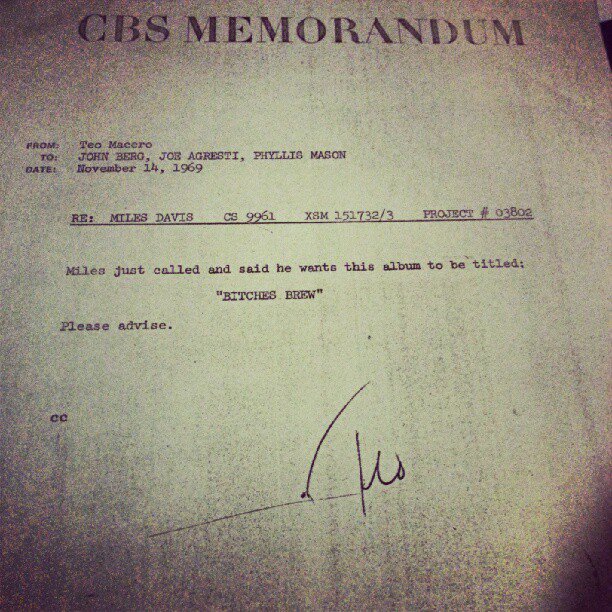
No wonder Miles and Teo worked so well together.
Wednesday, October 31, 2012
Kashmir
I've been wondering: how does watching bands like the Beatles, the Rolling Stones and self-proclaimed golden gods Led Zeppelin turn into what are undeniably old men affect our view on aging? I mean, look at these guys:
They're old. (Well, three of them are.) They look great, each in their own way. Jimmy Page looks incredibly cool (if incredibly sweaty), John Paul Jones appears to be a decade younger than the others—closer in age to whippersnapper Jason Bonham—and Robert Plant looks like one badass beach bum who's barely been out of the sun since the 70s. He looks cool. He looks great. But he's old.
Does seeing the cute Beatle get increasingly jowly and obviously dye his hair make us feel our mortality all the more, or is the fact that he's still playing (wonderfully) to stadiums full make us feel like there's no need to get put out to pasture at the ripe old age of 64?
I don't know. And I'm not really going anywhere with this. I just wonder what effect, if any, it's had on those of us who grew up listening to rock and roll as time marches on, both for us and for the bands we listened to back when we was young.
Let the sun beat down upon my face
Does seeing the cute Beatle get increasingly jowly and obviously dye his hair make us feel our mortality all the more, or is the fact that he's still playing (wonderfully) to stadiums full make us feel like there's no need to get put out to pasture at the ripe old age of 64?
I don't know. And I'm not really going anywhere with this. I just wonder what effect, if any, it's had on those of us who grew up listening to rock and roll as time marches on, both for us and for the bands we listened to back when we was young.
Tuesday, October 30, 2012
Here Comes the Flood
Sure, PG was using it metaphorically, but even there, the need for community shines through.
Lord, here comes the flood
We'll say goodbye to flesh and blood
If again the seas are silent In any still alive
It'll be those who gave their island to survive
Drink up, dreamers, you're running dry.
Lord, here comes the flood
We'll say goodbye to flesh and blood
If again the seas are silent In any still alive
It'll be those who gave their island to survive
Drink up, dreamers, you're running dry.
Monday, October 29, 2012
The Road and the Sky
For my peeps on the east coast. Stay dry, my friends.
Now can you see those dark clouds gathering up ahead?
They're going to wash this planet clean like the Bible said
Now you can hold on steady and try to get ready
But everybody's gonna get wet
Don't think it won't happen just because it hasn't happened yet
Now can you see those dark clouds gathering up ahead?
They're going to wash this planet clean like the Bible said
Now you can hold on steady and try to get ready
But everybody's gonna get wet
Don't think it won't happen just because it hasn't happened yet
Friday, October 26, 2012
Sugar Ray Macca
I like pop. Melody is, as no one says, my jam, and pretty much regardless of style or trends, in the modern era, at least, pop equals melody. The beat may vary, the production certainly does, but melody is a constant in the majority of pop music.
So I liked Sugar Ray. What can I say? I did. Not enough to give them any money, but when one of their three or four songs I knew came on, I enjoyed them. I know it's not cool to admit it—hell, it wasn't cool to admit it back when they were selling millions of records, it certainly ain't cool now. But it's been a mighty long time since I cared what people thought of my taste in music, and back when I did care, I had the metabolism of a jackrabbit and, what the hell, even back then, back when I cared, I really didn't care much. I mean, listen to this intro:
It's "Ventura Highway" with a nice groove and less ridiculous lyrics. And if the band's sense of humor isn't exactly on a Monty Python level, well, I give 'em credit for not just trying to look cool. Is frontman Mark McGrath kind of annoying? Sure, but a lot of that may just be how much I wish I had his looks (certainly his hair and his abs). And, yeah, his voice is kinda nasally, but on the other hand, I found out not too long ago that he lived, for at least a little while, in the same small Connecticut town as me at the same time. So, you know: represent, my brotha.
Same goes with (what I think was?) their last hit:
Again, catchy melody, decent enough lyrics, prominent acoustic guitar set against a cool beat: for a guy like me, what's not to like? (Answer: the silly Robbie Robertson-like conducting of the other band members during the lovely acappella intro. Just...no.)
And here's my point. Tonight it hit me that Sugar Ray's basic DNA can be found right here:
Oh, sure, sure. I know, I know. "Band influenced by Beatles" isn't exactly news. Even to be influenced by a former-Beatle's post-Beatles work isn't exactly earth-shattering. But that's not what I'm talking about. I'm not talking about having been influenced by the Fabs, although clearly the band was. I'm not even talking about having McCartneyesque influences or bits and bobs. I'm talking about this specific post-Beatles Paul McCartney song being the basis for Sugar Ray's biggest hits.
It's all there, save the nasally voice. That's Sugar Ray's entire hit template, one sub-3:00 tossed-off ditty, later sped up slightly. I mean, jeez, listening to the section from about 1:42 until the end, it feels like Sugar Ray owes a certain British knight royalties.
Saturday, October 20, 2012
A Newbie's Live Dinosaur Jr Primer
So my old college roomie, Dave, is going to go see Dinosaur Jr in a few weeks. Once I was able to get past the blinding jealousy, I was filled with excitement for him, getting to see one of the great American bands of the 80s and 90s and, what the hell, this century so far, not to mention the absolute best band reunion ever—I don't think it's even close.
Dave knows some Dino Jr and obviously likes what he's heard 'cuz duh how could anyone not? But as he's not a huge, long-time fan, I looked at recent setlists and decided to put together a very brief primer for someone going to their first DJ show: just a handful of tunes he's likely to hear live, maybe a third of their total set.
Let's start with their current single, the delightfully crunchy yet as always ever so melodic "Watch the Corners," with the brief, sudden and (hitherto) unexpected acoustic interlude, from their new album, I Believe in Sky.
They've also been playing the slower, grindier "See It On Your Side" a lot this tour, again from the new album.
Going back to their second album, they almost always play "The Lung." (My writing that, of course, means they're probably about to drop it from the set.)
But they go even further back, playing "Forget the Swan," off their 1985 debut, almost every time out, including an oddly large percentage of TV appearances.
Maybe their best-known song—other than their utter killer cover of The Cure's "Just Like Heaven"—is their sadly autobiographical yet utterly transcendent "Freak Scene."
And that's about it. I could add the insanely catchy "Little Fury Things"—the very first Dinosaur Jr I ever heard and three seconds in I swear I knew I was going to be a fan for life—or "Out There" which, if not my very favorite DJ song ever is certainly Top 3. I could say to prepare to be amazed by the ferocity and dexterity of J Mascis's soloing or how he wears his heart on his sleeve in his lyrics yet can barely seem to be arsed to actually sing them, much less talk to the audience, or the bizarrely chordal bass playing of the much more outgoing Lou Barlow who never seems to have been told that the bass is traditionally plucked and not strummed. And Murph's drumming? How he seems to want to destroy his drum kit as quickly and violently as possible? His glorious tonsorial style? His overall diaphoretic appearance? In fact, I could go on for hours about Dino Jr, something Dave well knows.
But I won't. Instead, I'll just leave with one last, incomparable and utterly perfect pop song.
Good golly. I may need to borrow her cigarette.
Oh...and bring earplugs. Seriously, trust me on this. You're welcome in advance.
Dave knows some Dino Jr and obviously likes what he's heard 'cuz duh how could anyone not? But as he's not a huge, long-time fan, I looked at recent setlists and decided to put together a very brief primer for someone going to their first DJ show: just a handful of tunes he's likely to hear live, maybe a third of their total set.
Let's start with their current single, the delightfully crunchy yet as always ever so melodic "Watch the Corners," with the brief, sudden and (hitherto) unexpected acoustic interlude, from their new album, I Believe in Sky.
They've also been playing the slower, grindier "See It On Your Side" a lot this tour, again from the new album.
Going back to their second album, they almost always play "The Lung." (My writing that, of course, means they're probably about to drop it from the set.)
But they go even further back, playing "Forget the Swan," off their 1985 debut, almost every time out, including an oddly large percentage of TV appearances.
Maybe their best-known song—other than their utter killer cover of The Cure's "Just Like Heaven"—is their sadly autobiographical yet utterly transcendent "Freak Scene."
'cuz when I need a friend it's still you. Now you're fired. See you in fifteen years.
But I won't. Instead, I'll just leave with one last, incomparable and utterly perfect pop song.
Good golly. I may need to borrow her cigarette.
Oh...and bring earplugs. Seriously, trust me on this. You're welcome in advance.
Wednesday, October 17, 2012
God Bless the Child
(NOTE: Out of respect for some of the people mentioned in this post, many of whom I haven't been in touch with for 15 years and wouldn't know how to get in touch with today, I have changed their names. Just FYI.)
About 15 or so years ago a friend of mine got me involved in doing some acting for a local theatre company. I hadn’t acted since high school and, well, I wasn’t exactly a star back then. In fact the last show I had been in before 1996 was 10 years earlier during my senior year of high school with “Anything Goes,” (Scott was in it too, only with a much bigger part) and I was literally in the very first scene and then didn’t appear again before the curtain call. It was not resumé material.
About 15 or so years ago a friend of mine got me involved in doing some acting for a local theatre company. I hadn’t acted since high school and, well, I wasn’t exactly a star back then. In fact the last show I had been in before 1996 was 10 years earlier during my senior year of high school with “Anything Goes,” (Scott was in it too, only with a much bigger part) and I was literally in the very first scene and then didn’t appear again before the curtain call. It was not resumé material.
But for whatever reason my friend Kathy, a method-trained actor for whom theatre was not just a break from her job as a therapist but also an extension of it, thought I would enjoy acting and had a part for me to play. It was in an original show called “The Man Who Knew Trotsky,” a Jewish family systems drama written by a friend of ours, and I played a large role as a troubled 30-something Jewish man who was married to a junkie stripper and was having an affair with his estranged older brother’s girlfriend. No, it didn’t exactly hit close to home. I don't have an older brother. (Hee!)
Anyway doing the show was an eye-opener and for a little while I got very into doing plays. I did about five of them in an 18 month period before it was time to take a break. It was indeed therapeutic and fulfilling and felt extremely healthy.
But the last show I did with Kathy was a show she had been wanting to do for years and years, a show about the Vietnam War. It came to be called “Who By Fire,” named after the haunting Leonard Cohen incantation, and it was the story of Vietnam Vietnam
Kathy was an amazing director and remains an amazing person, and she pulled it off. She found a few Vietnam
One in particular—we'll call him Bob—was severely troubled by the war and struggled for years and years. Bob was (and I hope still is) a loud, music-loving, ultra-liberal, long-haired, wisecracking force of nature whose experiences in Vietnam scarred him in ways that non-military folks like myself can really never, ever imagine. But he was also a blast to work with and he took to the stage with an almost unnerving natural grace. Many of the stories that made up the play were his own, a couple of them funny but several absolutely terrifying.
At the time I was not yet 30, married but not yet a father, and I was to be both Kathy’s assistant director as well as play a role in many of these vignettes. In one, called “Kid” and based on a story from the book Nam by Mark Baker, I played a deeply troubled kid trying to live with what he saw in Vietnam
Now the people who sent you there to meet me are gone
And the people who sent me there to meet you are gone…
…and everyone just wants to be friends.
Why didn’t they think of that first?
Before we met that day?
The most grueling part that I was in was also written by Bob, and was the story of a badly under-qualified 2nd Lieutenant (played by me) whose panic and terrible planning got a large number of Bob’s fellow soldiers killed one night. It remains the single hardest thing I have ever done in my relatively brief acting career, and it stays with me to this day.
“All these men are dead because of you!” he screamed toward the end of the scene, slamming my head into the stage while I turned into a puddle laying on the ground. “Because of YOU!”
Again, doing “Who By Fire” was one hell of an experience. But one of the coolest things Kathy did was ask Bob, Don and Ernie—the three main players and all of whom had served in Vietnam America
But best of all is a song Bob chose for a skit called “C.O.” Which was a story told by Don about a conscientious objector that had been stationed in his unit. It was a matter-of-fact story about a man who would not fight and would not carry a weapon, yet who still served his country and served in Don’s unit. He was ostracized by many of them, but he still served, quietly and with a sense of purpose and focus and patriotism that Don made clear to us.
For this portion of the show Bob chose a piece of music that you maybe wouldn’t think would fit, but did so beautifully. Billie Holiday’s wondrous “God Bless the Child.”
Them that's got shall get
Them that's not shall lose
So the Bible said and it still is news
Mama may have, Papa may have
But God bless the child that's got his own
Yes, the strong gets more
While the weak ones fade
Empty pockets don't ever make the grade
Mama may have, Papa may have
But God bless the child that's got his own
Money, you've got lots of friends
Crowding round the door
When you're gone, spending ends
They don't come no more
Rich relations give
Crust of bread and such
You can help yourself
But don't take too much
Mama may have, Papa may have
But God bless the child that's got his own
Mama may have, Papa may have
But God bless the child that's got his own
That's got his own
He just worry 'bout nothin'
Cause he's got his own
It’s a socially conscious song dating way back to 1941, about poverty and want and the exclusion of those who haven’t got, brought to life by Holiday's angelic voice. But it’s also about being alone and forgotten, and the ability some of us have to deal with that and still forge our way forward. It was written at least a decade before anybody ever heard of Vietnam, but the words seemed to apply 100 percent to this conscientious objector I had never met, yet seemed to know quite well by the time the five-minute vignette had ended.
God bless them.
Monday, October 15, 2012
John Denver
This past weekend was the 15th anniversary of John Denver’s death in a plane crash. I can still recall being home from work for the Columbus Day holiday and IMing (ah, those AOL days!) with a friend about the news. It was jarring to learn, even though I really hadn’t thought about John Denver or his music in years and years.
But certain artists, like certain songs, are imprinted in you, as Scott recently wrote. And once the imprinting takes hold, it very seldom lets go.
[That sound you just heard was Scott doing a Victorian swoon and falling to the floor, unconscious. So stunned to learn that yes, I actually read his posts.]
But with John Denver there was certainly a connection that went way, way back to well before my musical tastes were even formed. It goes back to the early 70s and being barely 6 or 7 years old and hearing his music play in the house. Our house was a split level, with the TV room (we called it the family room) downstairs and the formal living room, sans TV but with stereo speakers, upstairs.
My dad had a pretty expansive stereo system back then and it was also housed in the family room—I recall it being seven different pieces, not including large speakers up in said living room and smaller speakers up on shelves in the family room. But there was a custom-made cherry-wood stereo cabinet that was the size of a couch and maybe four feet high, and in it it held my dad’s turntable, receiver, dual-casette deck and 8-track player (yes, Virginia, it was the 70s), along with separate equalizer and Dolby system components as well as an old reel-to-reel tape player my dad had from, I am guessing, dating back to the 60s. The cabinet also held his entire cassette, 8-track and record collection—there were easily a few hundred of them in there.
But with the speakers upstairs and down, and the general openness of the split level design, a record or tape being played on my dad’s stereo system would be heard throughout the entire house, even up in the bedrooms on the top floor. Easily. If music was on, everyone heard it.
And this is where John Denver (and others) crept into my subconscious, where he still resides today. My parents were big fans of his and his music would play throughout the house on Saturdays and Sundays, or maybe during family events or holidays. And sure, by the time I was 10 I was ready to never hear him again.
But as it is with music, time brings with it revisited and reclaimed appreciation. The same way we can hear, say, “Free Bird” or “Won’t Get Fooled Again” today and recognize them for the sheer musical masterpieces they are (whereas when they played non-stop on FM radio 25 years ago we grew dead tired of them and wouldn’t have minded if we never heard them again), so too can the music of our childhood become desirable again.
The truth is John Denver was a fine songwriter with a very nice, clear voice and a wonderful sense of melody. He didn’t write angry or confrontational and he met no one's definition of dangerous or edgy, but his songs—particularly his love songs—always came through with a sharp sense of confidence, a singer-songwriter in command of his material. His was a decidedly American sound and, born out of the American folk movement as he was, it certainly sounds like it belongs to an American era of the past. But play the songs today and they interestingly enough do not sound dated. That’s impressive in itself.
Case in point—maybe his finest song.
Sure, it’s sentimental and makes a play for the heartstrings. But it’s also honest and on-point, and it possesses such a damn lovely guitar lead and gently moving vocal line that it’s easy to forgive any melodrama that may come with it. And it stays inside you for a long time—it did with me anyway. And the main reason? It’s not necessarily rooted in Pavlovian conditioning or even subdural trickery. It’s way simpler.
It stays with us because it’s good, sweet music. Period. That’s something Henry John Deutschendorf, Jr. left as a lasting legacy. And imprinted, I am guessing, in many, many of us.
Thanks for that, sir. Greatly ‘preciated.
Subscribe to:
Posts (Atom)